Design and Implementation of a Microcontroller-Based Home Automation System
DOI:
https://doi.org/10.65521/itsi-teee.v5i1.4256Keywords:
Abstract
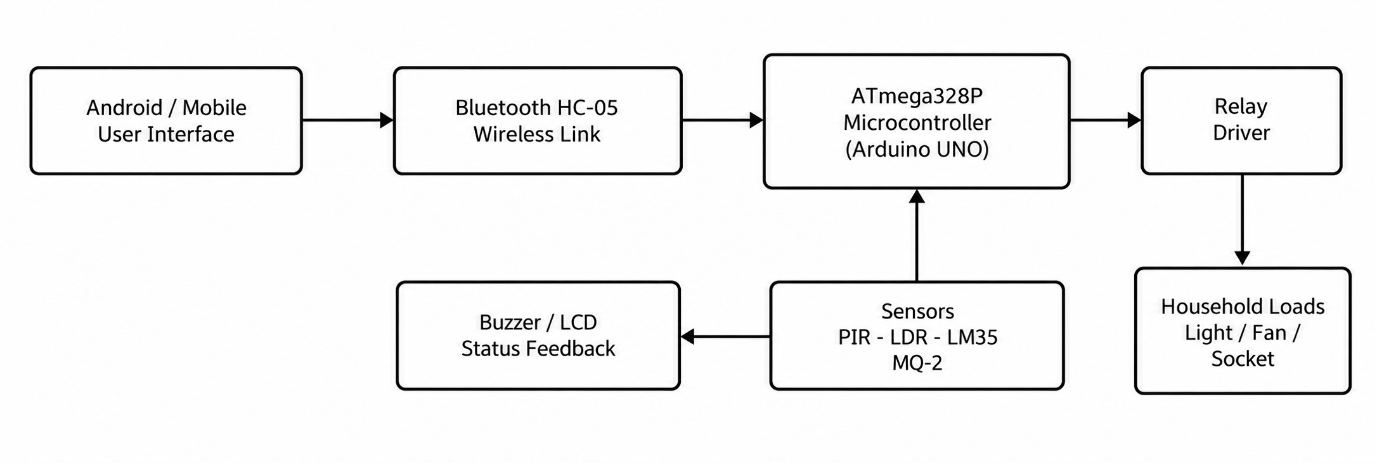
Home automation systems integrate embedded controllers, communication interfaces, sensors, and switching circuits to provide convenient and energy-aware control of domestic appliances. This methodology paper presents the design and implementation framework of a low-cost microcontroller-based home automation system intended for lighting, fan, socket, safety, and environmental monitoring applications. The proposed prototype employs an ATmega328P microcontroller as the central controller, an HC-05 Bluetooth module for short-range wireless command transfer, electromechanical relays for isolated load switching, and PIR, LDR, temperature, and gas sensors for automatic responses. The software architecture uses command decoding, sensor acquisition, threshold comparison, relay-state control, and status feedback as sequential tasks within the microcontroller firmware. The methodology defines hardware selection, circuit interfacing, control logic, communication protocol, safety isolation, and a repeatable validation procedure. Representative prototype-validation data indicate reliable command execution, sub-second local wireless response, and correct automatic actuation under the defined sensor thresholds. The proposed architecture emphasizes low cost, modularity, manual override, simple maintenance, and expandability, making it suitable as an academic prototype and as a foundation for more advanced Internet-connected smart-home systems.