A Survey of Methods and Architectures for Steerable Constrained Output-Feedback Control for MEMS Gyroscopes Using Steerable Graph Neural Networks with Limited Transmission Bandwidth
DOI:
https://doi.org/10.65521/itsi-teee.v13i2.3866Keywords:
Abstract
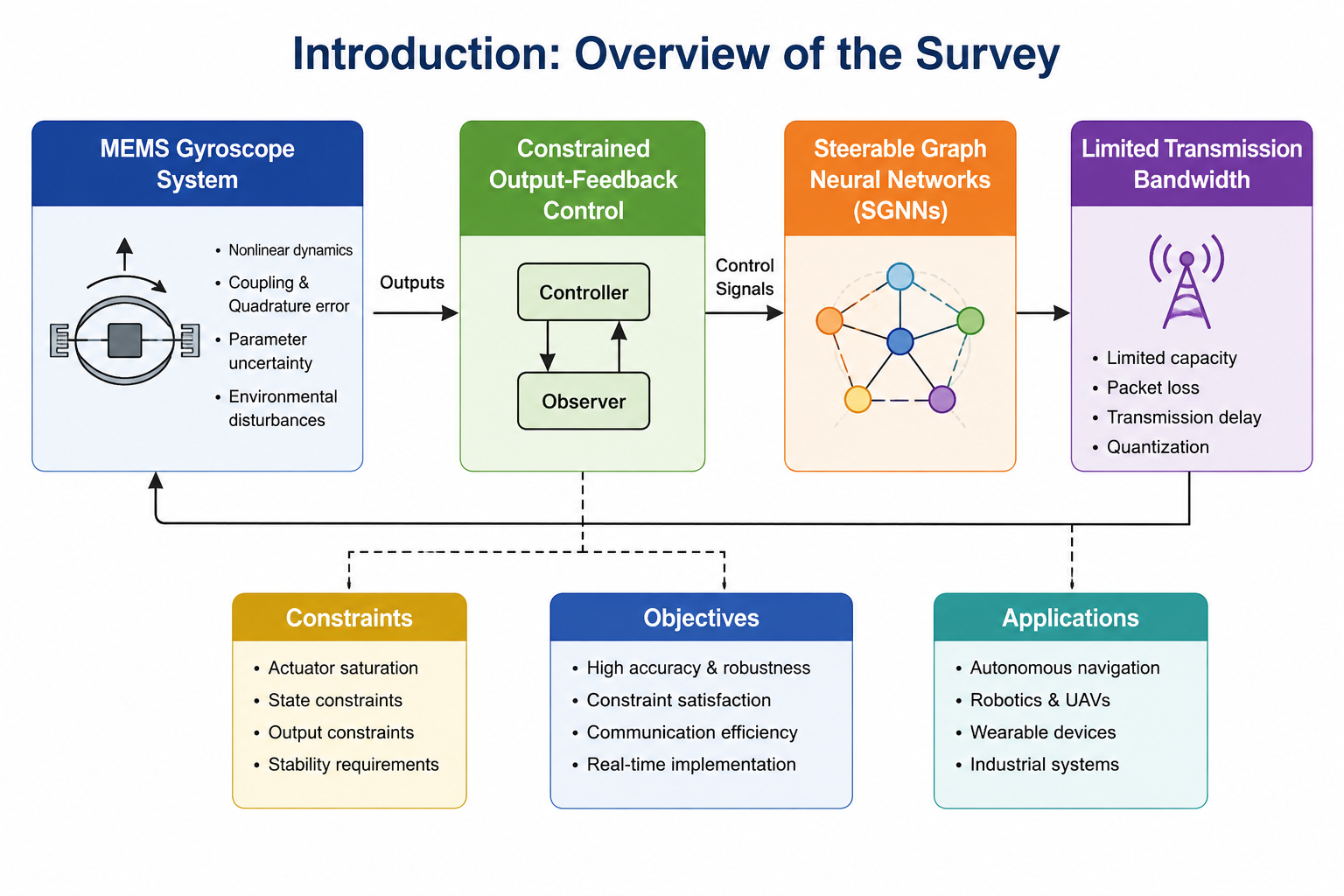
Microelectromechanical Systems (MEMS) gyroscopes are essential components in inertial navigation, robotics, autonomous vehicles, aerospace, wearable electronics, and industrial automation due to their compact size, low power consumption, and high sensitivity. However, their performance is significantly affected by nonlinear dynamics, fabrication imperfections, environmental disturbances, parameter uncertainties, and limited communication resources, making conventional control methods insufficient for high-precision applications. This survey presents a comprehensive review of steerable constrained output-feedback control techniques for MEMS gyroscopes, emphasizing the integration of Steerable Graph Neural Networks (SGNNs) under limited transmission bandwidth. The review examines constrained output-feedback controllers, observer-based estimation methods, event-triggered communication strategies, graph neural network architectures, and bandwidth-aware optimization frameworks reported. SGNNs exploit rotational equivariance and graph-structured learning to accurately model complex gyroscope dynamics while improving robustness, generalization, and data efficiency compared with conventional deep learning approaches. Furthermore, event-triggered and self-triggered communication protocols reduce network traffic and energy consumption without compromising closed-loop stability. The comparative analysis highlights recent advances, identifies key limitations related to computational complexity, scalability, and real-time implementation, and discusses future research directions including explainable AI, edge intelligence, federated learning, and hardware-software co-design for next-generation intelligent, communication-efficient, and adaptive MEMS gyroscope control systems.