Design and Implementation of a Microcontroller-Based Automatic Energy Meter Reading System
Keywords:
Abstract
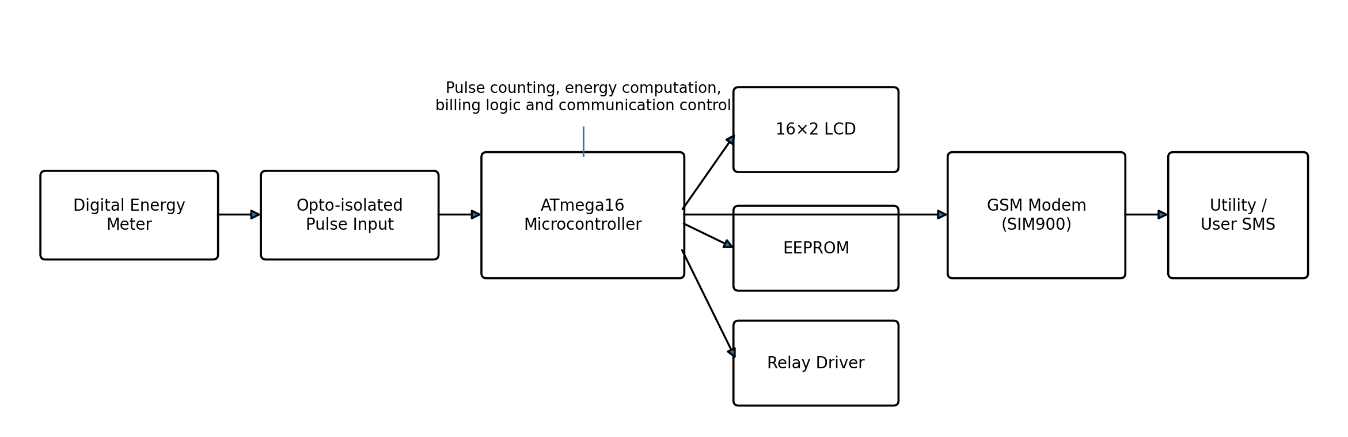
Automatic meter reading (AMR) removes the need for repeated manual visits to consumer premises and can improve the timeliness, traceability, and accuracy of electricity billing. This paper presents a methodology for the design and implementation of a low-cost microcontroller-based automatic energy meter reading system intended for single-phase residential or small commercial installations. The proposed architecture interfaces the pulse output of a digital energy meter with an ATmega16 microcontroller through electrical isolation. The controller counts metering pulses, converts the pulse total into kilowatt-hours, stores cumulative consumption in non-volatile memory, displays local information, and communicates the latest reading to a utility or consumer through a GSM short-message link. A relay interface is included as an optional controlled output for service connection or disconnection. The methodology defines the hardware interface, firmware logic, message format, error checking, and bench-test procedure. Representative validation data show close agreement between reference energy and pulse-derived energy, while repeated communication trials demonstrate reliable transmission under normal signal conditions. The resulting design is modular, inexpensive, and compatible with the AMR concepts reported in the literature up to 2015. The paper emphasizes reproducible implementation steps rather than a proprietary metering platform.