Development of an Arduino-Based Home Automation System with GSM Technology
DOI:
https://doi.org/10.65521/itsi-teee.v9i1.4210Keywords:
Abstract
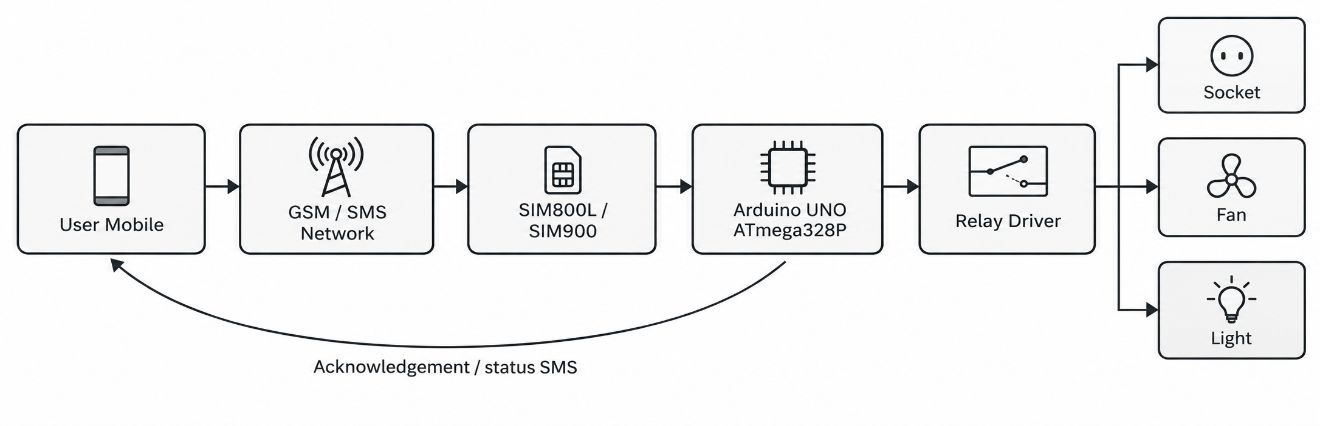
This paper presents a methodology for developing a low-cost home automation system in which an Arduino UNO operates as the central controller and a GSM module provides remote control through Short Message Service (SMS). The design is intended for situations in which Internet connectivity is unavailable, unstable, or undesirable, while cellular service remains accessible. The proposed architecture integrates an Arduino UNO, SIM800L/SIM900-class GSM modem, opto-isolated relay module, regulated power supply, household loads, and a command-authentication routine. A stepwise engineering method is defined for requirements identification, hardware selection, circuit integration, SMS command parsing, sender authorization, relay actuation, acknowledgement generation, and safety-oriented testing. Earlier work established the practicality of GSM/SMS control, Arduino prototyping, and low-cost smart-home architectures; however, the present methodology emphasizes a simple command protocol, restricted authorized numbers, fail-safe output initialization, and reproducible validation criteria. Because no physical laboratory dataset was supplied for this paper, the Results section reports software-in-the-loop and design-level validation rather than claiming unperformed field measurements. The logical controller correctly classified valid, invalid, and unauthorized commands in the test set, and the proposed verification matrix provides a direct route for later hardware testing. The methodology is suitable for student prototypes and small residential installations where inexpensive remote switching, basic feedback, and independence from broadband Internet are primary requirements.