Energy-Aware IoT Control and Performance Evaluation of a Solar-Powered Smart Irrigation System
DOI:
https://doi.org/10.65521/itsi-teee.v10i1.4223Keywords:
Abstract
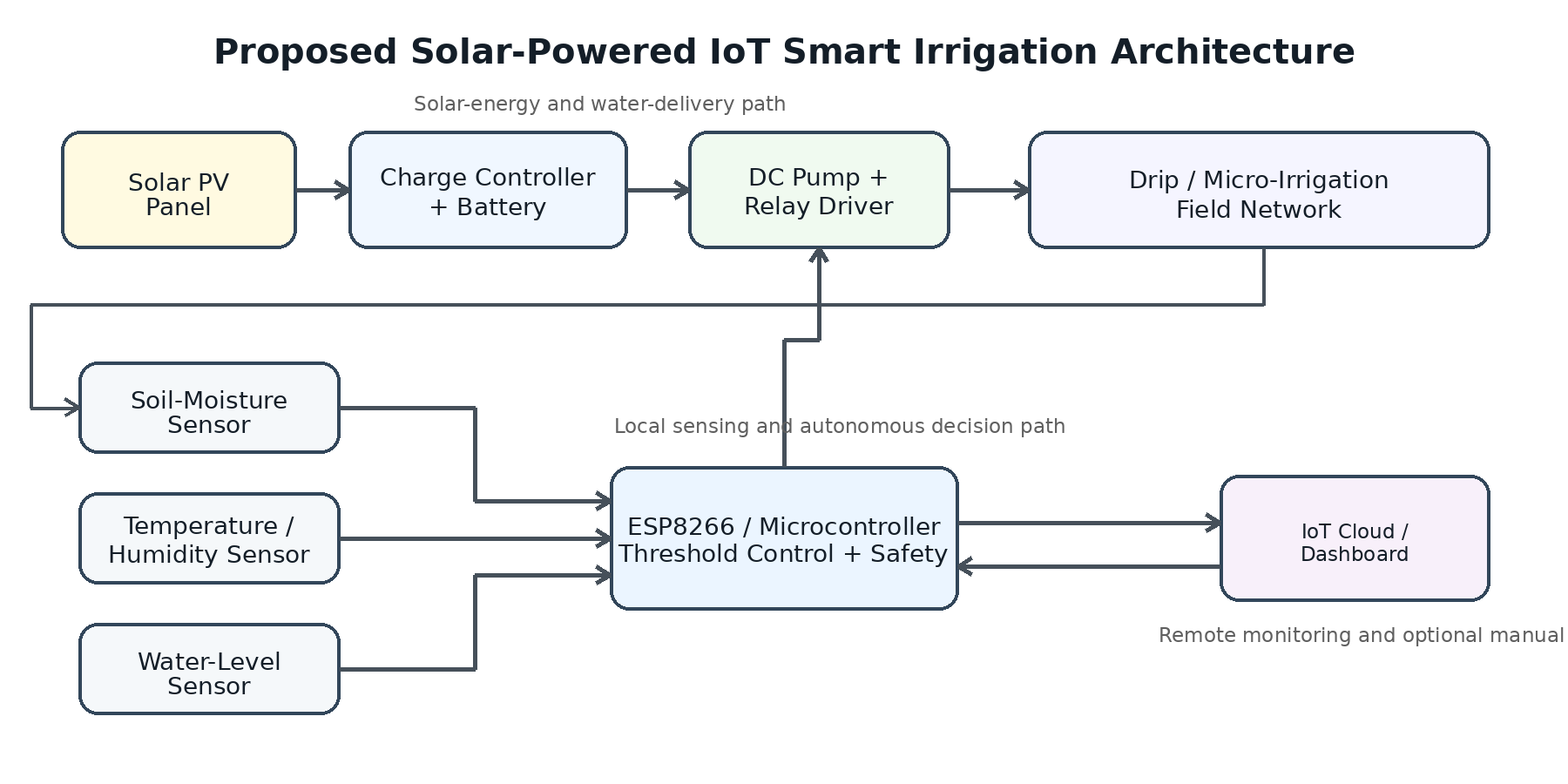
Water scarcity, irregular grid supply, and inefficient irrigation scheduling continue to constrain agricultural productivity, particularly in remote and smallholder farming environments. This methodology paper proposes a solar-powered smart irrigation system in which photovoltaic energy, soil and environmental sensing, embedded control, and Internet of Things (IoT) connectivity are integrated into a closed-loop irrigation architecture. The system uses a solar photovoltaic panel, charge controller, battery, low-voltage pump, soil-moisture sensor, temperature-humidity sensor, water-level sensor, and an ESP8266-class controller connected to an IoT dashboard. Irrigation is initiated when calibrated soil moisture falls below a lower threshold and is stopped when an upper threshold is reached, while reservoir level and battery voltage operate as safety constraints. The proposed methodology combines hardware design, sensor calibration, threshold-based control, solar-energy sizing, IoT data transmission, and comparative performance analysis. For a representative 100 Wp photovoltaic module, 12 V-20 Ah battery, 60 W pump, and 3 W average electronics load, the energy-balance analysis indicates approximately 375 Wh/day of harvest under five peak-sun-hours and 75% system derating, compared with an estimated 150 Wh/day demand under smart scheduling. A scenario-based seven-day irrigation analysis indicates a potential water-use reduction of about 35% relative to fixed manual irrigation while maintaining soil moisture within a selected control band. The study provides a reproducible methodology for designing and evaluating off-grid IoT irrigation systems without overstating unverified field performance.