Design and Performance Analysis of a Solar-Powered Smart Irrigation System Using IoT
DOI:
https://doi.org/10.65521/itsi-teee.v9i1.4198Keywords:
Abstract
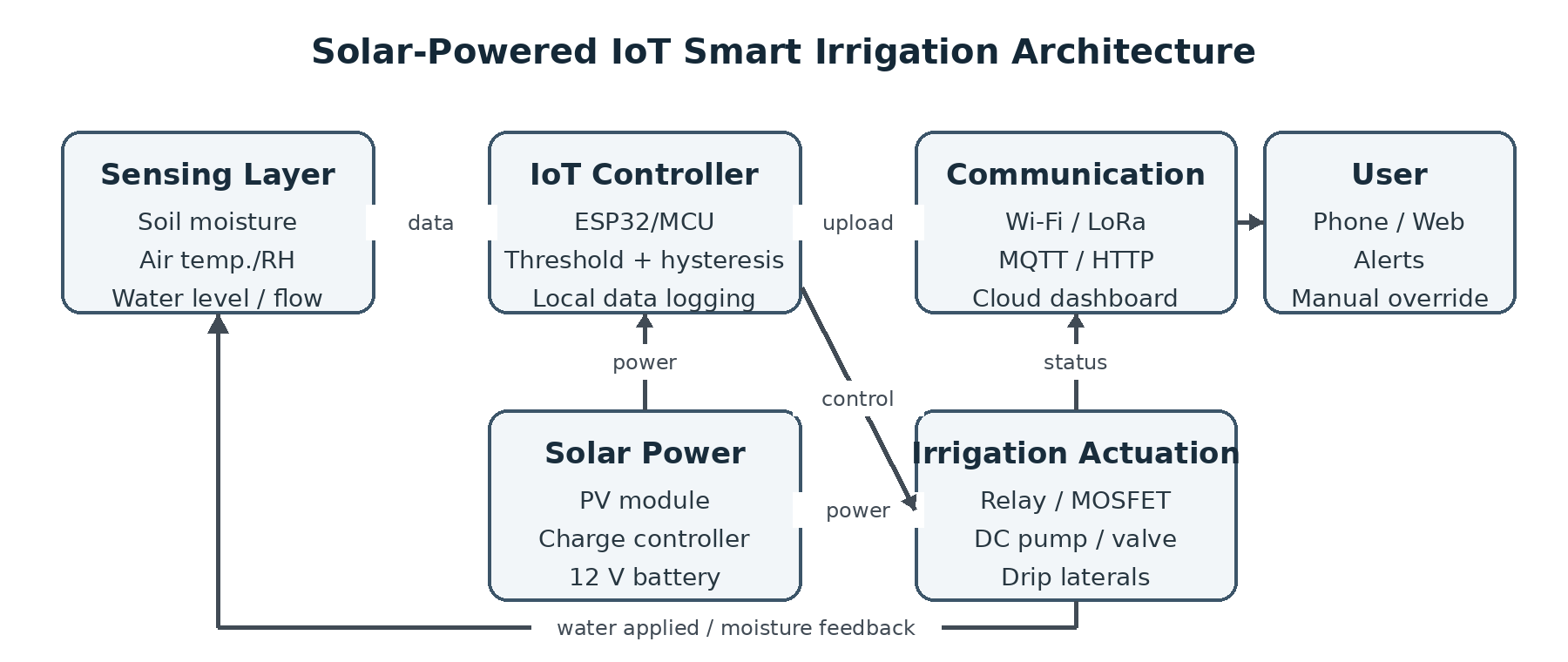
Efficient irrigation is increasingly dependent on the ability to apply water according to actual root-zone demand while maintaining reliable operation in locations where grid electricity and communication infrastructure may be limited. This methodology paper presents the design and performance-analysis framework for a solar-powered smart irrigation system that integrates soil-moisture sensing, environmental monitoring, an IoT-enabled microcontroller, a photovoltaic power subsystem, cloud-based supervision, and automated pump control. The proposed architecture uses feedback from soil moisture and water-flow sensors to trigger irrigation only when a lower moisture threshold is reached and to stop irrigation after recovery to an upper threshold. Solar photovoltaic generation and battery storage supply the controller, communication interface, and DC pump. System sizing is based on daily electrical load, available peak-sun-hours, battery depth of discharge, and hydraulic demand. Performance is evaluated through water-use reduction, pump-energy consumption, moisture-regulation quality, communication reliability, response latency, and energy autonomy. A representative design-level simulation indicates that threshold-based irrigation can reduce applied water and pump runtime by approximately 30% compared with fixed-time irrigation while maintaining soil moisture inside the target band for a larger fraction of the operating period. The framework provides a reproducible basis for later field validation without claiming simulated values as field measurements.