Recent Advances in Optimized Graph Transformer with Alpine Skiing Optimization: Improving Initiative IoT in Human Resource Management by Predicting Workers’ Stress: A Systematic Review
DOI:
https://doi.org/10.65521/itsi-teee.v13i1.3838Keywords:
Abstract
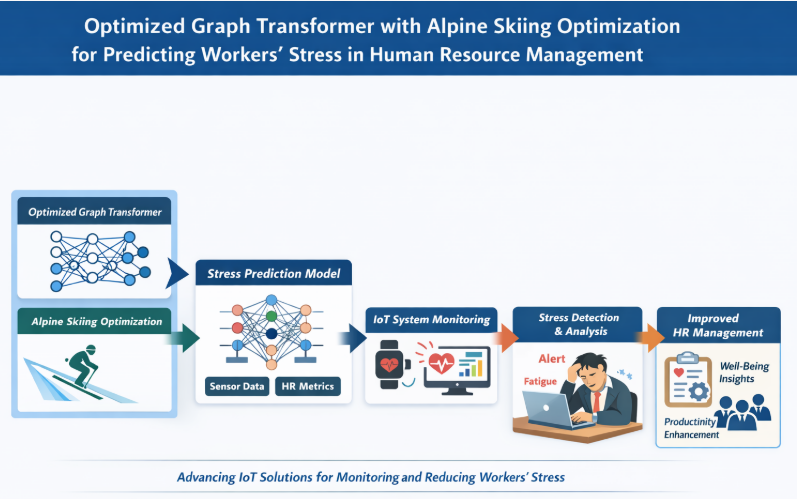
The integration of Internet of Things (IoT) technologies in human resource management (HRM) has enabled real-time monitoring of employee well-being, particularly stress detection. Recent advancements in graph-based deep learning models, especially Graph Transformers, have shown significant potential in capturing complex relational dependencies within heterogeneous IoT data streams. Concurrently, nature-inspired optimization techniques such as Alpine Skiing Optimization (ASO) have emerged as efficient strategies for enhancing model convergence and performance. This systematic review presents a comprehensive analysis of recent developments in optimized Graph Transformer architectures combined with ASO for predicting workers’ stress in IoT-driven HRM systems. The study evaluates existing methodologies, datasets, optimization frameworks, and performance metrics while identifying research gaps and challenges. Emphasis is placed on how graph attention mechanisms improve contextual understanding of physiological, behavioral, and environmental data, and how ASO contributes to hyperparameter tuning and model efficiency. The review synthesizes findings from recent literature to highlight trends, strengths, and limitations in current approaches. Furthermore, it explores the implications of predictive stress analytics for proactive HR decision-making and workplace well-being. The results indicate that hybrid models integrating Graph Transformers with advanced optimization algorithms significantly outperform traditional machine learning techniques in terms of accuracy, scalability, and adaptability. This paper aims to guide future research toward developing robust, scalable, and privacy-preserving intelligent HRM systems using IoT and optimized deep learning frameworks.