Design and Development of a Microcontroller-Based Automatic Power Factor Correction System
DOI:
https://doi.org/10.65521/itsi-teee.v6i1.4243Keywords:
Abstract
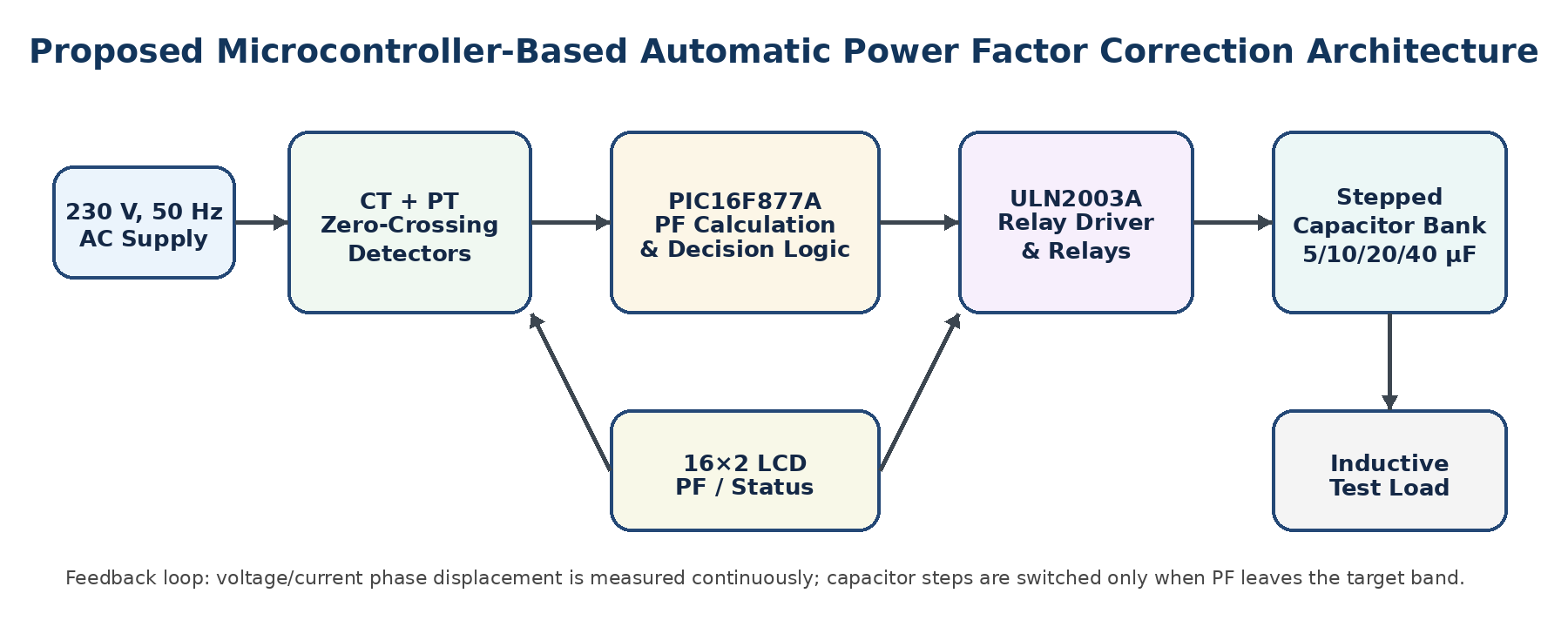
Low power factor caused by inductive loads increases line current, conductor losses, voltage drop, and the apparent-power demand of electrical installations. This methodology paper presents the design and development of a low-cost automatic power factor correction (APFC) system in which a microcontroller continuously estimates the phase displacement between voltage and current and switches a stepped shunt-capacitor bank to maintain the power factor near a selected target. The proposed hardware uses isolated voltage and current sensing, zero-crossing detectors, a PIC16F877A microcontroller, a ULN2003A relay driver, electromechanical relays, a 5/10/20/40 µF capacitor bank, and a 16×2 display. The control method calculates power factor from the zero-crossing time difference, estimates the required reactive-power compensation, selects the closest capacitor combination, and applies hysteresis and switching delay to prevent relay hunting. Design verification is performed for representative 230 V, 50 Hz inductive loads rather than being presented as a field trial. Analytical validation indicates that typical initial power factors between 0.62 and 0.81 can be raised to approximately 0.94–0.99 with corresponding line-current reductions of about 15–37%. The methodology emphasizes electrical isolation, capacitor discharge, conservative switching, and calibration so that the design can be reproduced in an educational or small-load laboratory environment.