Design and Performance Analysis of a Grid-Connected Solar Photovoltaic Power Generation System
DOI:
https://doi.org/10.65521/itsi-teee.v8i1.4215Keywords:
Abstract
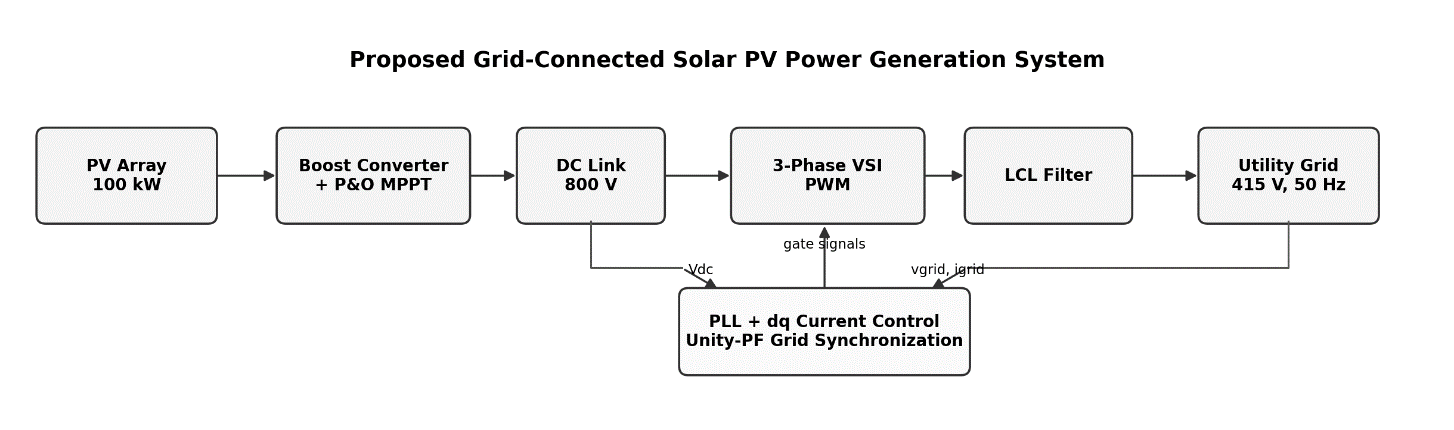
Grid-connected photovoltaic (PV) generation has become a practical route for converting solar energy into utility-compatible electrical power without local battery storage. This paper presents a compact methodology for designing and evaluating a 100 kW three-phase grid-connected solar PV system composed of a PV array, boost converter with perturb-and-observe maximum power point tracking (MPPT), regulated DC link, voltage-source inverter, LCL output filter, and synchronous-reference-frame grid controller. The PV source is represented through an irradiance- and temperature-dependent electrical model, while the conversion chain is evaluated by a numerical performance model under three representative irradiance levels. System design focuses on array sizing, DC-link selection, MPPT operation, inverter modulation, grid synchronization, and unity-power-factor current injection. A 100-kW array is formed using 400 modules arranged as 20 series modules in 20 parallel strings, providing an operating voltage near 614 V at standard test conditions. The boost stage regulates an 800 V DC link and supplies a 100 kVA three-phase inverter connected to a 415 V, 50 Hz utility grid. Model-based results show that AC power follows irradiance variation with an overall conversion efficiency of approximately 94-96%, while the grid current remains close to unity power factor. The study provides a reproducible design workflow that can be extended to higher-fidelity switching simulation or experimental validation.