Investigation of Waste Heat Recovery Systems for Improving Energy Efficiency in Internal Combustion Engines
DOI:
https://doi.org/10.65521/ijtarme.v10i1.4417Keywords:
Abstract
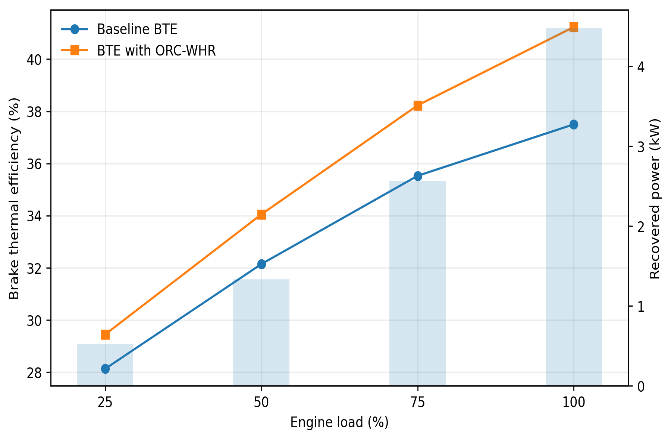
Internal combustion engines convert only part of the fuel chemical energy into useful brake work, while a substantial fraction is rejected through exhaust gases, coolant and other thermal pathways. This paper develops a compact methodology for investigating waste heat recovery (WHR) systems intended to improve engine energy efficiency. The approach combines a first-law engine energy balance, exhaust heat availability estimation, screening of Organic Rankine Cycle (ORC), thermoelectric generator (TEG) and turbocompounding options, and a detailed ORC performance model. A generic 45 kW compression-ignition engine operating at 25-100% load is used as the methodological case. Exhaust heat is calculated from mass flow rate, specific heat and exhaust-to-ambient temperature difference; recoverable heat is then corrected for heat-exchanger effectiveness and conversion efficiency. The model predicts that net ORC power increases from about 0.53 kW at 25% load to 4.48 kW at full load, raising brake thermal efficiency from 37.5% to about 41.2% at the rated point. The comparison shows that ORC offers the strongest efficiency potential for sustained medium-to-high loads, TEG provides compact solid-state recovery at lower conversion efficiency, and turbocompounding can be attractive where exhaust pressure energy is high. The methodology is suitable for preliminary design, sensitivity analysis and subsequent experimental validation.