Multi-Response Optimization of CNC Turning Conditions Using Central Composite Design and Response Surface Analysis
DOI:
https://doi.org/10.65521/ijtarme.v9i1.4415Keywords:
Abstract
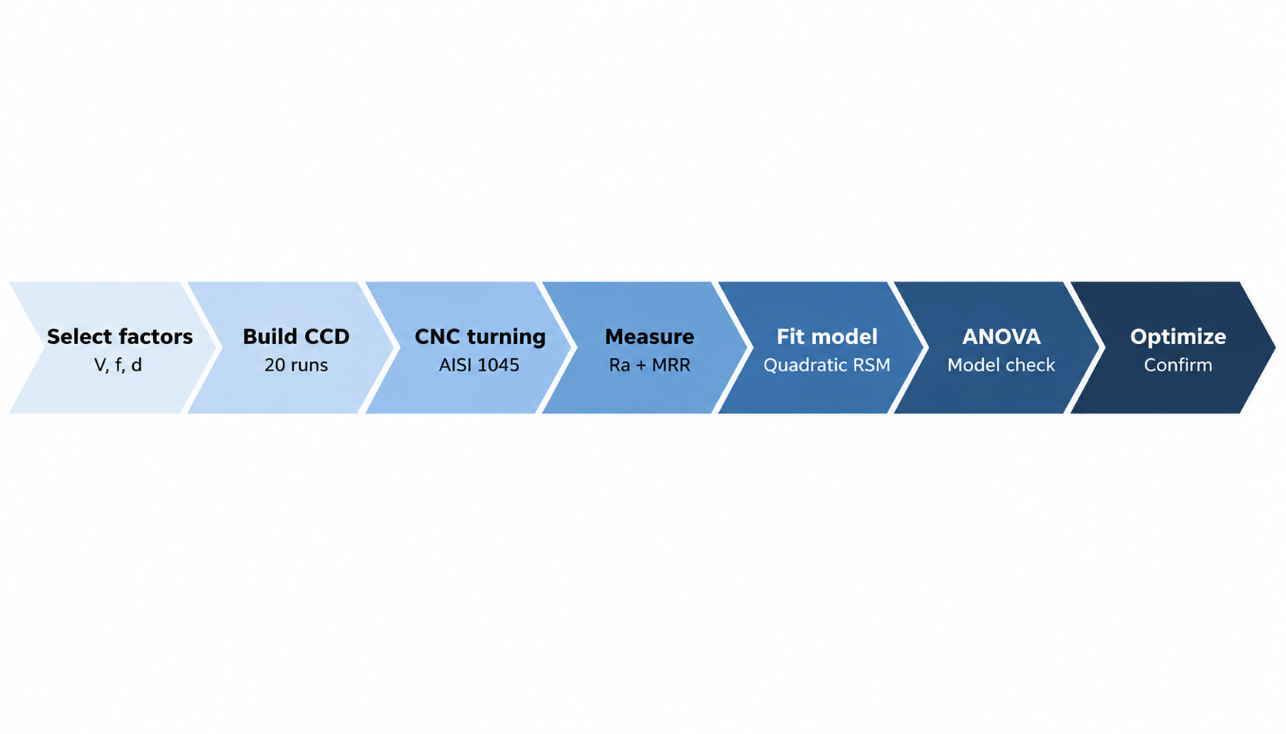
Efficient CNC turning requires a balanced selection of machining parameters because conditions that improve productivity may adversely affect surface quality. This study presents a statistically structured methodology for multi-response optimization of CNC turning conditions using a central composite design and response surface analysis. Cutting speed, feed rate, and depth of cut are treated as controllable factors, while average surface roughness and material removal rate are considered as the principal quality and productivity responses. A three-factor, 20-run central composite design is employed to estimate linear, interaction, and quadratic effects over a practical machining region. The proposed procedure is demonstrated for dry longitudinal turning of AISI 1045 steel using a coated carbide insert under controlled tool and workpiece conditions. Experimental responses are analyzed using second-order regression models, analysis of variance, lack-of-fit testing, residual diagnostics, and multi-response desirability optimization. The representative statistical analysis indicates that feed rate is the dominant contributor to surface roughness, while cutting speed and depth of cut provide secondary but significant effects. A balanced desirability solution is obtained near a cutting speed of 190 m/min, feed rate of 0.14 mm/rev, and depth of cut of 1.10 mm, with predicted surface roughness of approximately 0.82 µm and material removal rate of about 29,260 mm³/min. Representative confirmation values show prediction errors of approximately 3.5% for surface roughness and 1.2% for material removal rate. The methodology provides a reproducible framework for identifying CNC turning conditions that achieve an effective compromise between surface finish and machining productivity while reducing dependence on trial-and-error parameter selection.