
Towards Greener Logistics: AI-Driven Carbon Footprint Optimization for Smart Cities
DOI:
https://doi.org/10.65521/intjournalrecadvengtech.v14i3s.1752Keywords:
Abstract
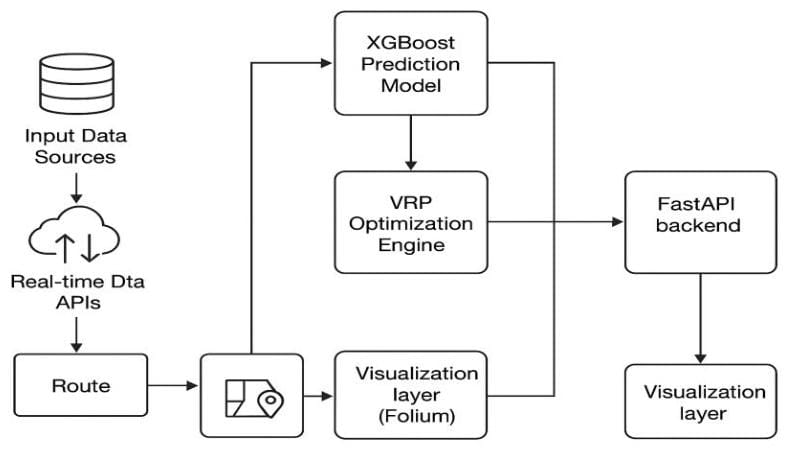
The rapid growth of logistics and computational infrastructures has substantially contributed to global carbon emissions, emphasizing the need for sustainable optimization solutions. This paper proposes an AI-powered Carbon Footprint Optimization (CFO) framework that minimizes CO2 emissions in supply chain logistics through intelligent route and resource planning. The system employs an XGBoost regression model trained on segment-level parameters such as distance, slope, cargo weight, traffic density, and weather conditions to accurately predict fuel consumption and emission levels. These predictions are integrated into a Vehicle Routing Problem (VRP), solved using Google OR-Tools, where the optimization objective focuses on minimizing carbon emissions rather than distance or time.
The framework also incorporates real-time traffic and weather data, ensuring adaptive and efficient route recommendations, while results are visualized through an interactive Folium-based map. Additionally, the study integrates concepts from Green Algorithms to quantify computational carbon footprints and ECO-CHIP methodologies to promote sustainable computing practices. Experimental results demonstrate that the proposed system significantly reduces emissions and enhances route efficiency compared to traditional distance-based approaches. This work establishes a scalable foundation for sustainable logistics, with potential extensions toward multi-vehicle optimization, reinforcement learning-based decision systems, and real-time carbon aware routing.
Downloads
Downloads
Published
How to Cite
Issue
Section
License

This work is licensed under a Creative Commons Attribution-NoDerivatives 4.0 International License.