
Sustainable Urban Development: The Role of Smart and Energy-Efficient Buildings: A Review
DOI:
https://doi.org/10.65521/intjournalrecadvengtech.v14i2s.1468Keywords:
Abstract
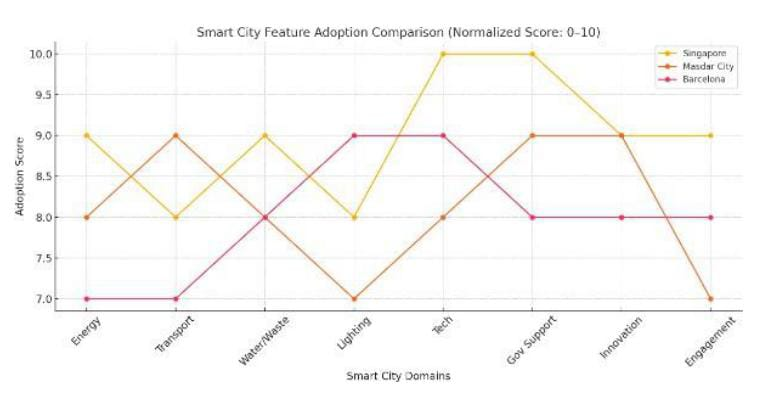
The accelerating pace of urbanization has significantly increased global energy demand, placing immense pressure on environmental sustainability. In response, the integration of smart technologies into urban planning has emerged as a promising solution for optimizing energy consumption and promoting eco-friendly development. This paper provides a comprehensive review of innovative approaches such as artificial intelligence (AI), the Internet of Things (IoT), smart grids, and renewable energy systems in shaping energy-efficient cities and buildings. Drawing from real-world case studies—including Singapore’s smart city framework, Masdar City’s sustainable urban planning, and The Barcelona city building design—the paper demonstrates how these technologies are applied in practice. While their impact is transformative, adoption remains limited due to challenges like cyber security vulnerabilities, high implementation costs, and policy misalignments. To overcome these obstacles, cross-sector collaboration is essential. Future research directions include leveraging AI for predictive energy management, enabling decentralized energy markets through block chain, and building climate-resilient infrastructure.
Downloads
Downloads
Published
How to Cite
Issue
Section
License

This work is licensed under a Creative Commons Attribution-NoDerivatives 4.0 International License.
