
Structural Health Monitoring of Reinforced Concrete Buildings Using Wireless Sensor Networks
Keywords:
Abstract
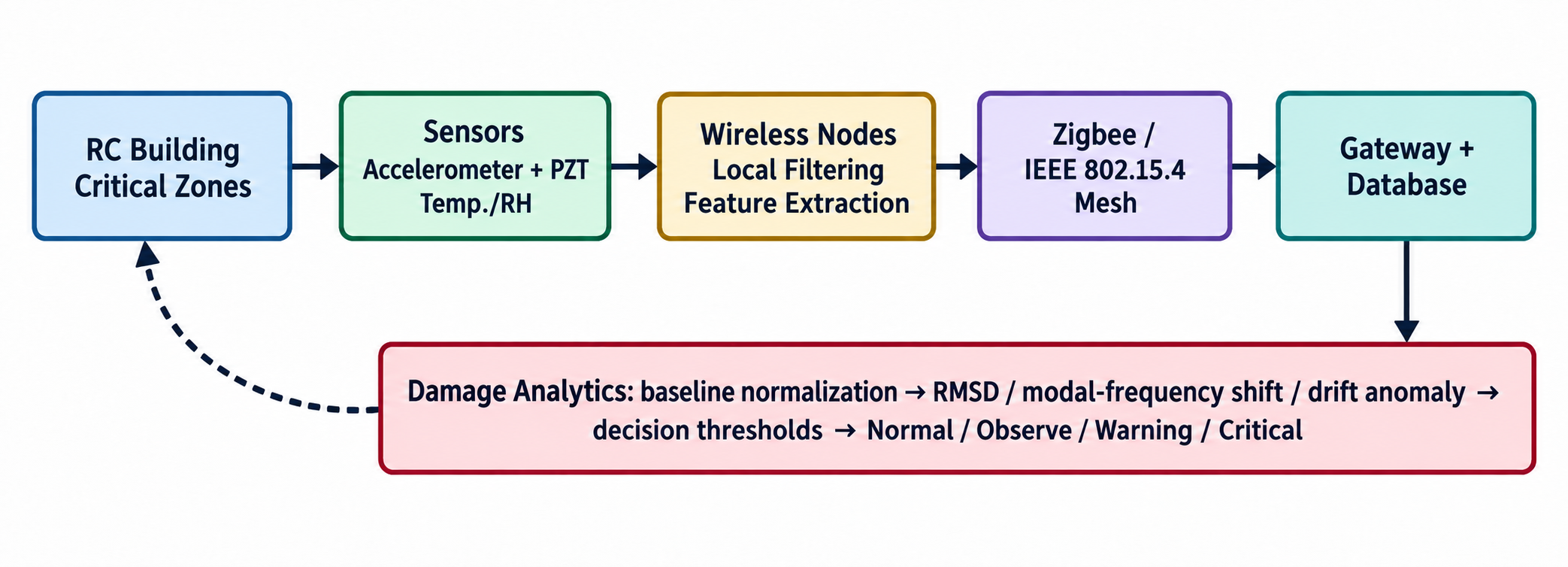
Reinforced concrete (RC) buildings deteriorate because of cracking, corrosion, fatigue, construction defects, environmental exposure, and extreme events. Periodic visual inspection can miss early-stage or inaccessible damage, while conventional wired structural health monitoring (SHM) systems can be expensive to install in multi-storey buildings. This methodology paper develops a wireless sensor network (WSN) framework for continuous condition assessment of RC buildings. The proposed system combines low-frequency accelerometers for global vibration response, piezoelectric lead-zirconate-titanate (PZT) or smart-aggregate sensing for local crack-sensitive measurements, and temperature/humidity sensors for environmental compensation. Sensor nodes perform time synchronization, filtering, local feature extraction, and IEEE 802.15.4/Zigbee-based multihop communication to a building gateway. Damage is evaluated by changes in modal frequency, inter-storey response, and PZT electromechanical/active-sensing signatures using a root-mean-square-deviation (RMSD) index relative to a healthy baseline. A staged validation protocol is proposed using healthy, minor, moderate, and severe damage conditions. Illustrative methodology-validation results show monotonic increases in the damage index together with progressive reductions in the first natural frequency while maintaining high packet-delivery reliability. The framework is designed to reduce cabling, support dense sensing, localize suspicious zones, and trigger tiered inspection alerts. It provides a practical research methodology for WSN-enabled SHM of RC buildings using technologies and evidence available up to 2019.
Downloads
Downloads
Published
How to Cite
Issue
Section
License

This work is licensed under a Creative Commons Attribution-NoDerivatives 4.0 International License.
