Design, Fabrication and Testing of a Low-Cost Electric Two-Wheeler with Hub-Motor Drive and Smart Battery Management
Keywords:
Abstract
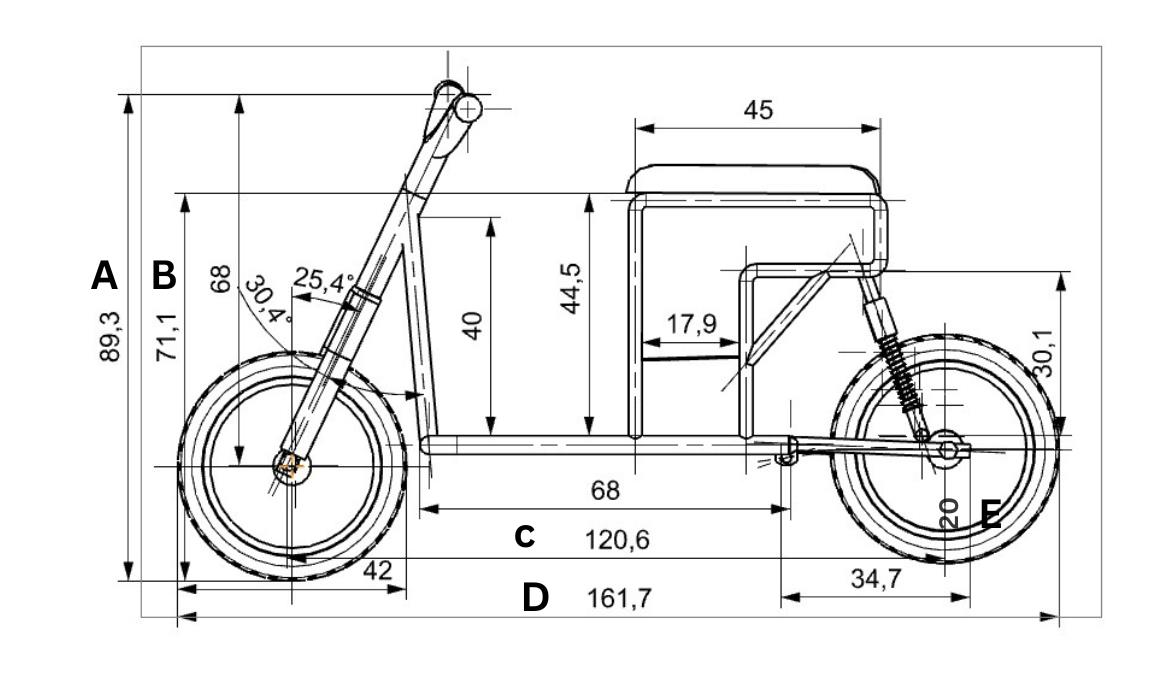
Electric two-wheelers offer a direct route to reducing urban transport emissions, but their adoption in price-sensitive markets is governed by capital cost rather than by technology. This paper reports the complete design, fabrication and testing of a low-cost electric two-wheeler built to a total materials and labour budget of ₹60,000, of which the battery accounts for half. The tractive-effort requirement was established analytically for a 95 kg vehicle at a design speed of 35 km/h by summing rolling resistance, aerodynamic drag, gradient resistance and acceleration force, giving a total tractive force of 123.4 N and a required propulsive power of 1200 W; a 1 kW hub motor was selected on this basis. The powertrain calculation, allowing 80 % depth of discharge, yields a 48 V, 26.04 Ah pack of 1250 Wh, charged by a 48 V, 5 A charger. The vehicle was fabricated in four phases over approximately three months: concept development, 2D and 3D design with finite-element structural analysis, frame fabrication and component integration, and validation testing. Testing comprised power-supply verification, system functionality checks, road trials over varied terrain, overload strength testing with multiple riders, braking distance measurement, ramp gradeability and bump stability. A cost breakdown, a component-wise service-life estimate and a comparison against petrol and commercial-EV alternatives are presented. Three internal inconsistencies in the recorded design data — in the frontal-area value, in the tractive-force summation used for torque, and in the quoted range and charging time — are identified explicitly rather than resolved silently, and the measurements needed to settle them are stated.