
Recent Advances in Segmentation and Classification of Renal Tumors Using EfficientNet-Based U-Net and Epistemic Neural Networks: A Systematic Review
DOI:
https://doi.org/10.65521/ijaeee.v14i2.1985Keywords:
Abstract
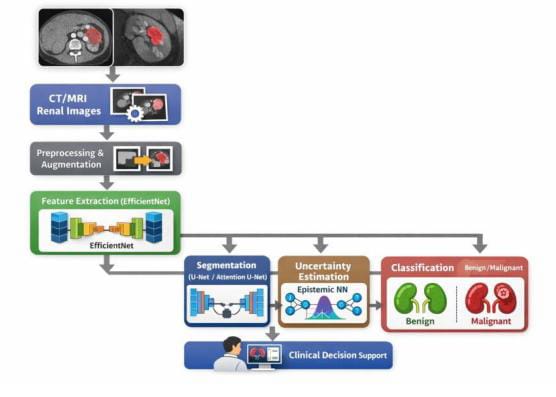
Renal tumor detection and segmentation are critical components in early diagnosis and treatment planning for kidney cancer. With the rapid evolution of deep learning, convolutional neural networks (CNNs), particularly U-Net-based architectures, have emerged as powerful tools for medical image segmentation. This review focuses on recent advances (2020–2023) in renal tumor segmentation and classification using EfficientNet-based U-Net models integrated with epistemic neural networks for uncertainty estimation. EfficientNet improves feature extraction through compound scaling, while U-Net ensures precise localization through encoder–decoder architecture. Additionally, epistemic neural networks enhance model reliability by quantifying uncertainty in predictions, which is crucial in clinical decision-making. Recent studies demonstrate that hybrid architectures, attention mechanisms, and multi-stage segmentation frameworks significantly improve Dice coefficients and Intersection-over-Union (IoU) scores. The KiTS19 and KiTS21 datasets remain standard benchmarks for evaluating model performance. Despite advancements, challenges such as data imbalance, computational complexity, and generalization across datasets persist. This systematic review synthesizes recent literature, compares methodologies, and identifies research gaps to guide future development of robust and clinically applicable renal tumor segmentation systems.
Downloads
Published
How to Cite
Issue
Section
License

This work is licensed under a Creative Commons Attribution-NoDerivatives 4.0 International License.
