A Study of Information Security Challenges and Cryptographic Solutions in Distributed Systems
DOI:
https://doi.org/10.65521/ijacte.v4i1.4602Keywords:
Abstract
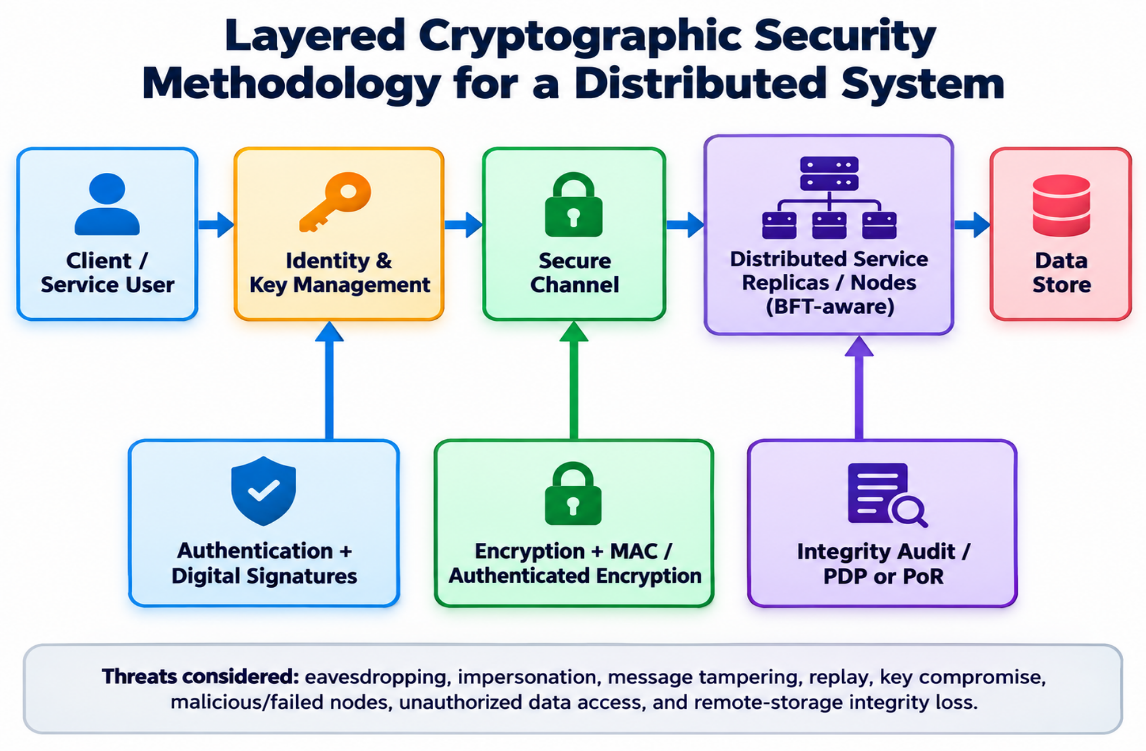
Distributed systems improve scalability, availability, and resource sharing by coordinating services across multiple networked nodes, but their open communication paths and decentralized trust also enlarge the security attack surface. This methodology paper studies major information-security challenges in distributed environments and maps them to cryptographic controls that were established in the literature up to 2015. The study uses a structured analytical method: threat identification, security-goal mapping, cryptographic control selection, and comparative evaluation of confidentiality, integrity, authentication, availability support, access-control flexibility, and operational overhead. The proposed layered security model combines public-key techniques for identity and key establishment, symmetric encryption and message authentication for efficient protected communication, digital signatures for origin assurance, secret sharing for resilient key custody, attribute-based encryption for fine-grained authorization, Byzantine fault-tolerant replication for malicious-node resilience, and remote data-possession checks for outsourced storage. Analytical results indicate that no single primitive is sufficient: secure distributed systems require coordinated controls across communication, identity, storage, and replication layers. The paper therefore presents a reusable methodology for selecting cryptographic mechanisms according to threat, trust boundary, performance cost, and desired security property.