Layered Cryptographic and Resilience Framework for Securing Distributed Systems
DOI:
https://doi.org/10.65521/ijacte.v4i1.4601Keywords:
Abstract
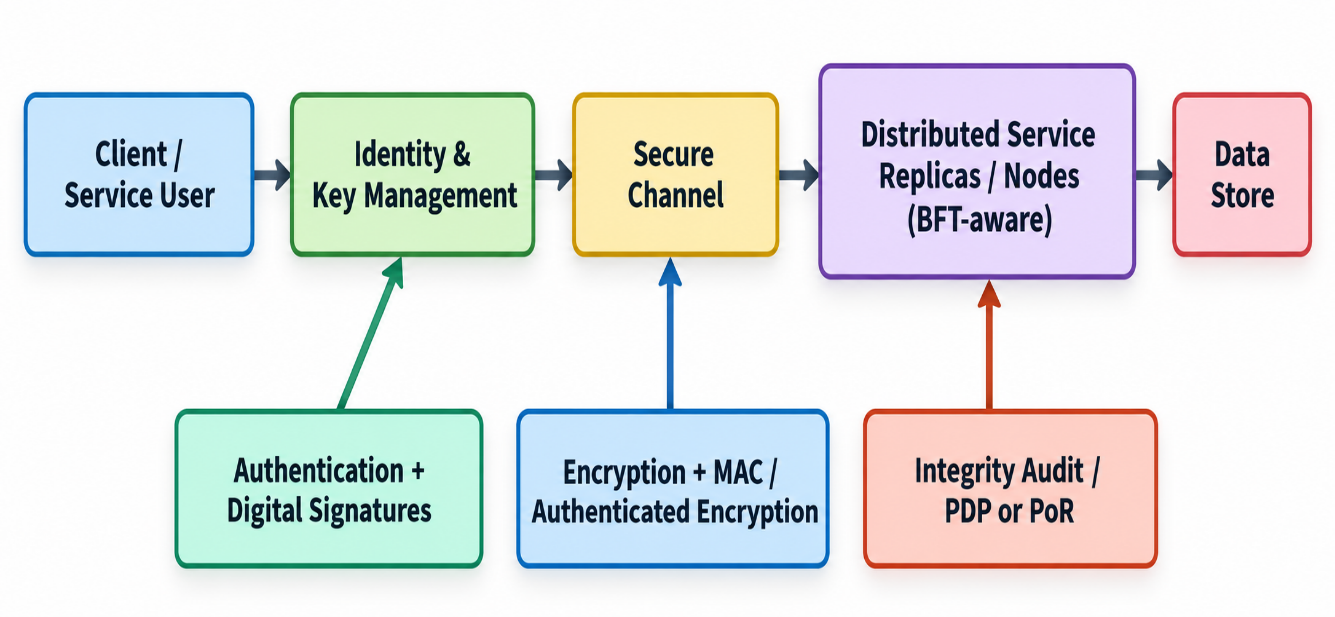
Distributed systems expose data and services to multiple trust boundaries, network paths, storage platforms, and replicated nodes, creating security requirements that cannot be addressed effectively by a single cryptographic mechanism. This study presents a layered security framework for selecting and combining cryptographic and resilience controls in distributed environments. The methodology begins with identification of assets and trust boundaries, followed by threat modeling, mapping of threats to security properties, selection of suitable cryptographic mechanisms, incorporation of distributed resilience controls, and evaluation of operational trade-offs. Public-key techniques are used for identity establishment, signatures, and session-key protection, while symmetric encryption and message authentication provide efficient confidentiality and integrity for high-volume communication. Secret sharing is considered for distributed key custody, attribute-based encryption for fine-grained authorization over protected data, Byzantine fault-tolerant replication for resilience against malicious service nodes, and provable data-possession mechanisms for verifying remotely stored information. The framework evaluates each control in terms of confidentiality, integrity and authentication, access-control capability, fault or storage resilience, and relative operational overhead. The analysis shows that hybrid communication protection provides efficient message security, attribute-based encryption offers strong policy-oriented access control at higher complexity, Byzantine fault tolerance strengthens service correctness and availability at significant coordination cost, and remote integrity proofs address storage-assurance requirements not provided by encryption alone. The findings demonstrate that secure distributed-system design depends on coordinated controls across identity, communication, storage, authorization and Replication layers.