Deep Learning and Steerable Graph Neural Networks for Output-Feedback Control of MEMS Gyroscopes
DOI:
https://doi.org/10.65521/ijacte.v13i2.3796Keywords:
Abstract
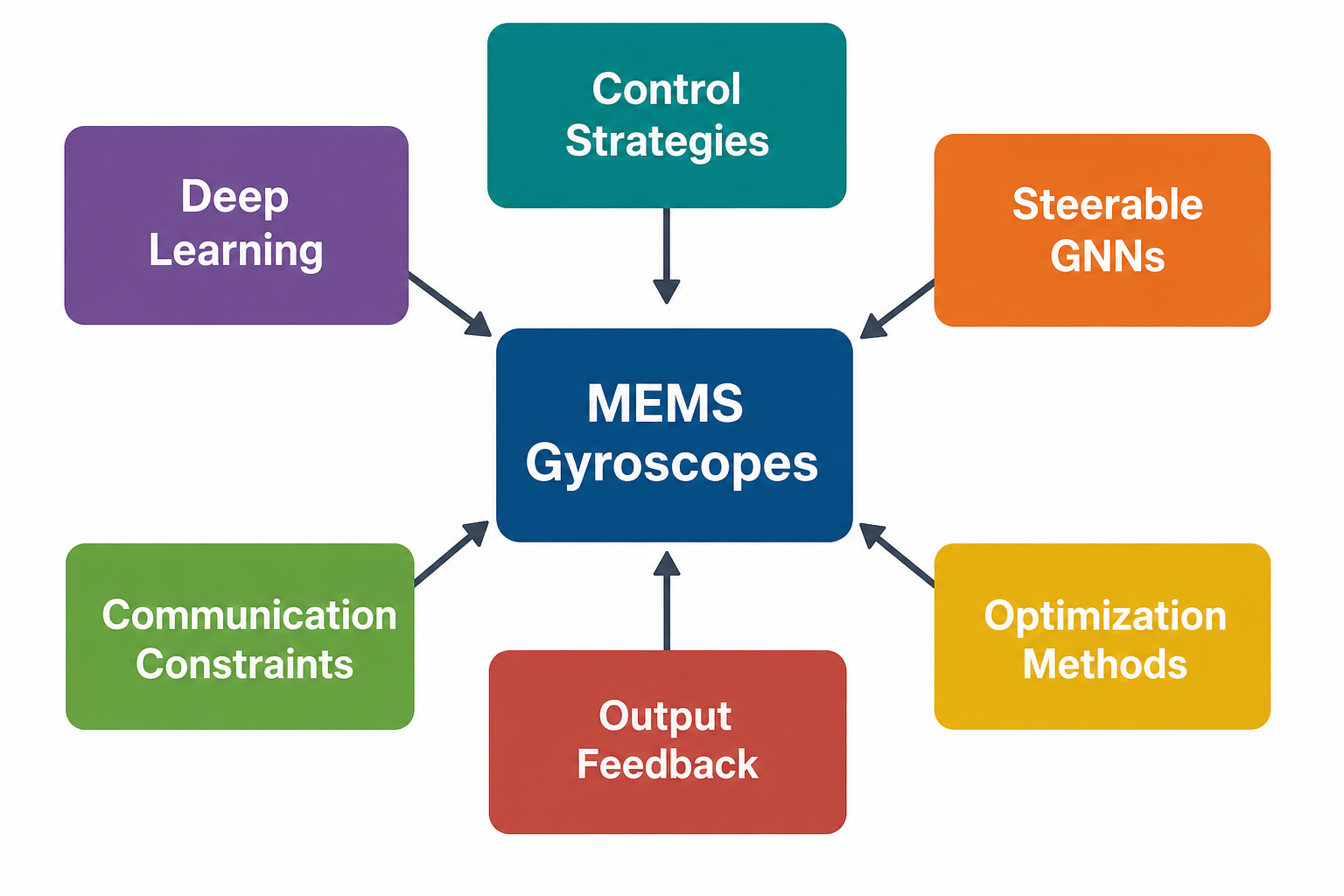
Microelectromechanical systems (MEMS) gyroscopes are widely used in inertial navigation, robotics, aerospace, automotive safety, and consumer electronics because of their compact size, low power consumption, and high sensitivity. However, their performance is affected by nonlinear dynamics, parameter uncertainties, fabrication imperfections, bias drift, environmental disturbances, and limited communication bandwidth, making accurate output-feedback control a challenging task. Conventional control techniques, including PID, adaptive, sliding mode, and backstepping control, often require precise mathematical models and full-state information, limiting their effectiveness in practical applications. This review presents a comprehensive analysis of deep learning and optimization approaches for steerable constrained output-feedback control of MEMS gyroscopes, emphasizing Steerable Graph Neural Networks (SGNNs) for intelligent control and state estimation. The survey covers graph neural networks, reinforcement learning, model predictive control, evolutionary optimization, particle swarm optimization, and communication-aware strategies such as event-triggered control, compressed sensing, and quantized feedback under bandwidth constraints. Comparative analysis highlights the advantages of SGNNs in exploiting geometric symmetries, improving robustness, reducing data requirements, and enhancing control accuracy under varying orientations. Finally, the review discusses current challenges, including computational complexity, interpretability, stability assurance, and real-time implementation, while identifying future research directions toward lightweight, physics-informed, and federated intelligent control frameworks for next-generation MEMS gyroscope systems.