An Explainable Artificial Intelligence Framework for Automated Software Defect Prediction and Quality Assurance in Large-Scale Software Systems
Keywords:
Abstract
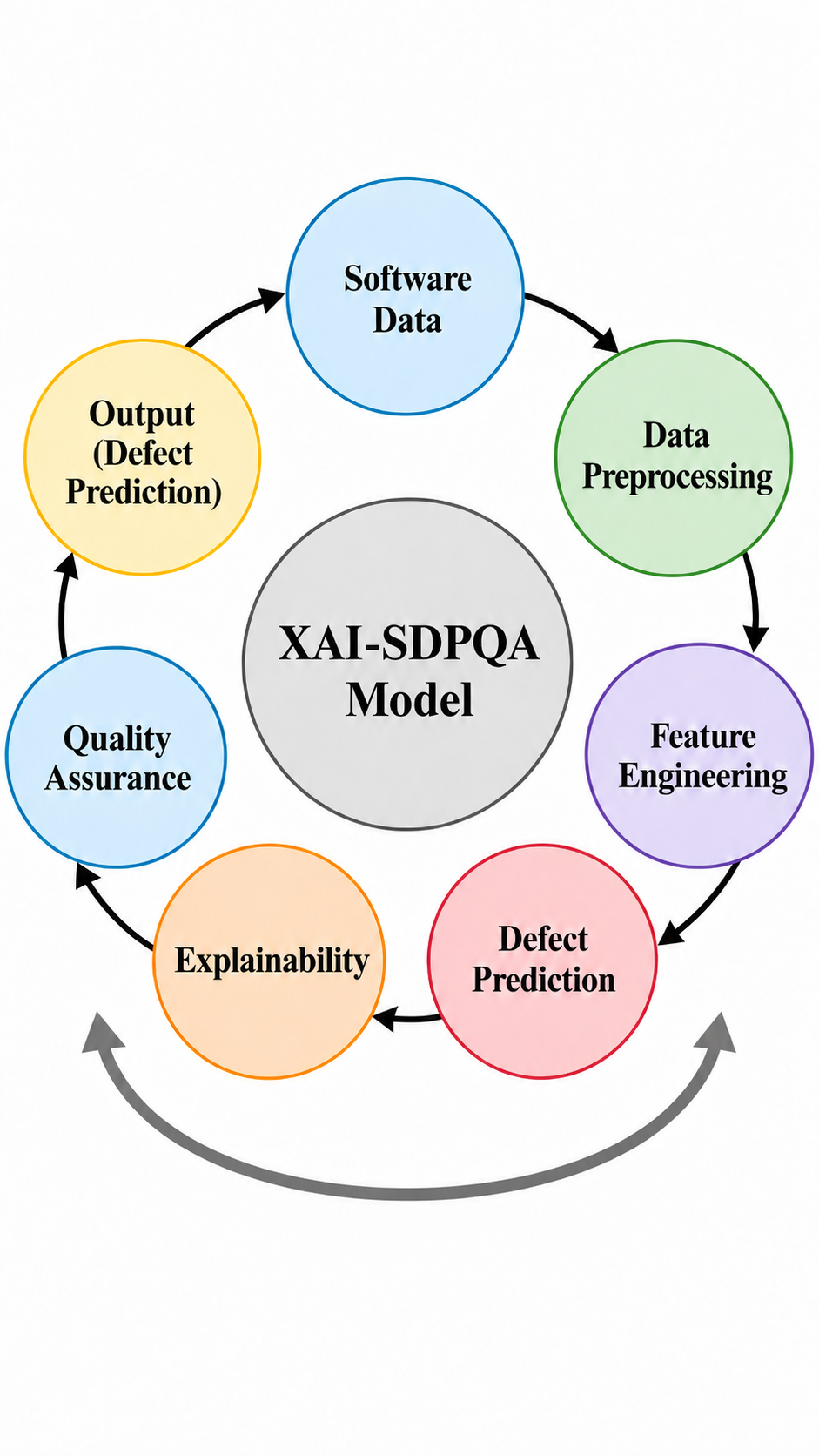
The increasing complexity of large-scale software systems has intensified the need for automated techniques capable of identifying defect-prone modules and supporting efficient software quality assurance. Conventional software defect prediction techniques frequently emphasize classification accuracy while providing limited information about the factors responsible for their predictions. This lack of interpretability can restrict the practical adoption of machine learning models within software testing and maintenance workflows. This study proposes an Explainable Artificial Intelligence Framework for Software Defect Prediction and Quality Assurance (XAI-SDPQA), integrating Random Forest, Extreme Gradient Boosting (XG Boost), and Shapley Additive explanations (SHAP). The framework incorporates data preprocessing, feature selection, class imbalance management, ensemble-based defect classification, prediction calibration, and explainable risk assessment. Historical software metrics are used to estimate defect probabilities, while SHAP-based analysis identifies feature contributions associated with individual predictions and overall model behavior. A risk-based quality assurance component is designed to prioritize software modules according to predicted defect probability and testing effort. The proposed framework is intended for evaluation using publicly available software defect datasets, including KC1, JM1, CM1, and PC1 from the NASA software metrics collections. A comparative experimental methodology is formulated using accuracy, precision, recall, F1-score, area under the precision–recall curve, and cost-aware testing effectiveness. The study presents an integrated architectural design, mathematical formulations, and reproducible evaluation procedures. The framework provides a methodological foundation for investigating interpretable and resource-aware software quality assurance, while empirical validation is required to establish its effectiveness.