
Machine Learning for Green Building Material Selection to Minimize Carbon Footprint in Large Residential Construction
Keywords:
Abstract
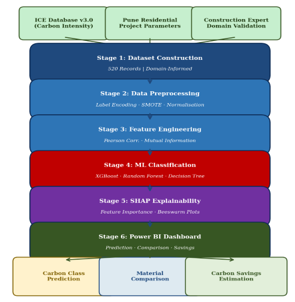
The construction sector is widely recognized as one of the largest contributors to global greenhouse gas emissions, with a substantial portion arising from the production and use of construction materials rather than operational energy consumption alone [1], [5]. While advancements in building design have improved energy efficiency during the operational phase, emissions associated with material extraction, manufacturing, transportation, and construction—collectively referred to as embodied carbon—remain insufficiently addressed in early project planning. This study presents a machine learning–based framework aimed at supporting sustainable material selection for large residential construction projects. The proposed system evaluates combinations of construction materials and classifies them into predefined carbon impact categories, enabling decision-makers to understand environmental implications at the design stage. A dataset consisting of 520 building scenarios was developed by integrating carbon intensity values from the Inventory of Carbon and Energy (ICE) database with region-specific construction parameters relevant to Pune, India. Three supervised machine learning models—XGBoost, Random Forest, and Decision Tree—were implemented and evaluated. Among these, the XGBoost model achieved the highest performance, with an accuracy of 94.2% and a macro F1-score of 0.942, demonstrating its effectiveness in handling structured construction data. To enhance interpretability, SHAP (SHapley Additive exPlanations) analysis was employed to identify the relative importance of input features, revealing that wall material, cement type, and structural system are the most influential factors affecting carbon classification [13]. An interactive Power BI dashboard delivers real-time predictions, material comparisons, and carbon savings, helping construction professionals make informed, sustainable decisions while integrating machine learning with tools to reduce environmental impact.
Downloads
Published
How to Cite
Issue
Section
License

This work is licensed under a Creative Commons Attribution-NoDerivatives 4.0 International License.
