A Review of Deep Learning and Optimization Approaches for Optimal Scheduling of PV-Battery-Electric Vehicle Loads Using Scalable Quantum Non-Local Neural Networks
Keywords:
Abstract
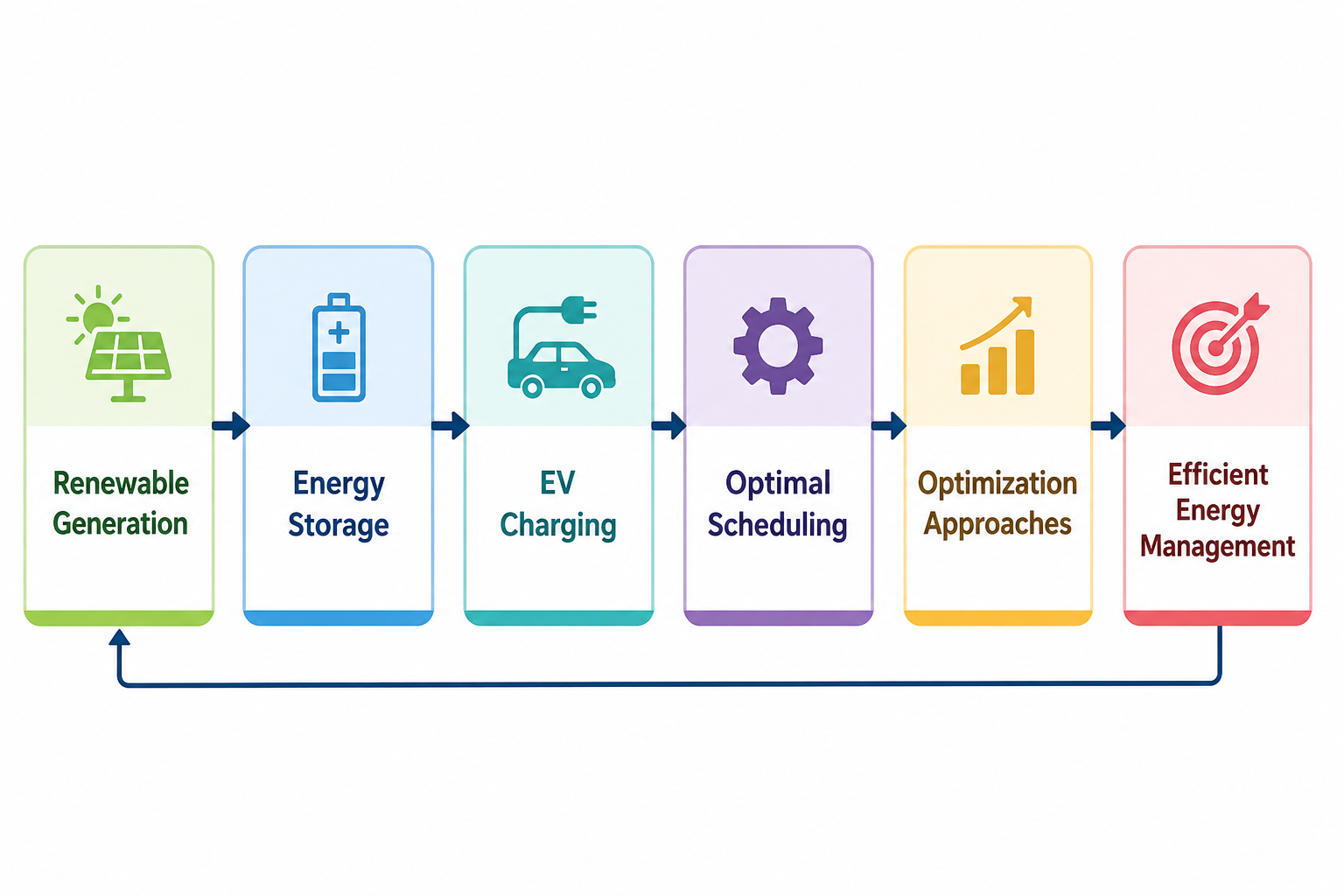
The rapid advancement of smart grid technologies and increasing integration of renewable energy resources have intensified the demand for intelligent energy management systems. Optimal scheduling of photovoltaic (PV) systems, battery energy storage systems (BESS), and electric vehicle (EV) loads is critical for ensuring grid stability, cost efficiency, and sustainability. However, the intermittency of solar generation, stochastic EV charging behavior, and nonlinear battery dynamics introduce significant challenges that traditional optimization techniques cannot effectively address. This review explores deep learning-driven optimization approaches, with a focus on scalable quantum non-local neural network (QNLNN) architectures for PV-battery-EV scheduling. These models capture long-range temporal dependencies using non-local operations, while quantum-inspired techniques enhance computational efficiency and optimization performance. Hybrid frameworks integrating deep learning with optimization methods such as particle swarm optimization, genetic algorithms, and reinforcement learning enable adaptive and robust scheduling strategies. The study examines applications across smart homes, microgrids, and vehicle-to-grid systems, utilizing datasets such as smart meter data, IEEE benchmarks, and solar irradiance profiles. Findings indicate that these approaches improve forecasting accuracy, reduce operational costs, and enhance renewable energy utilization, offering a scalable solution for intelligent and sustainable smart grid energy management systems.