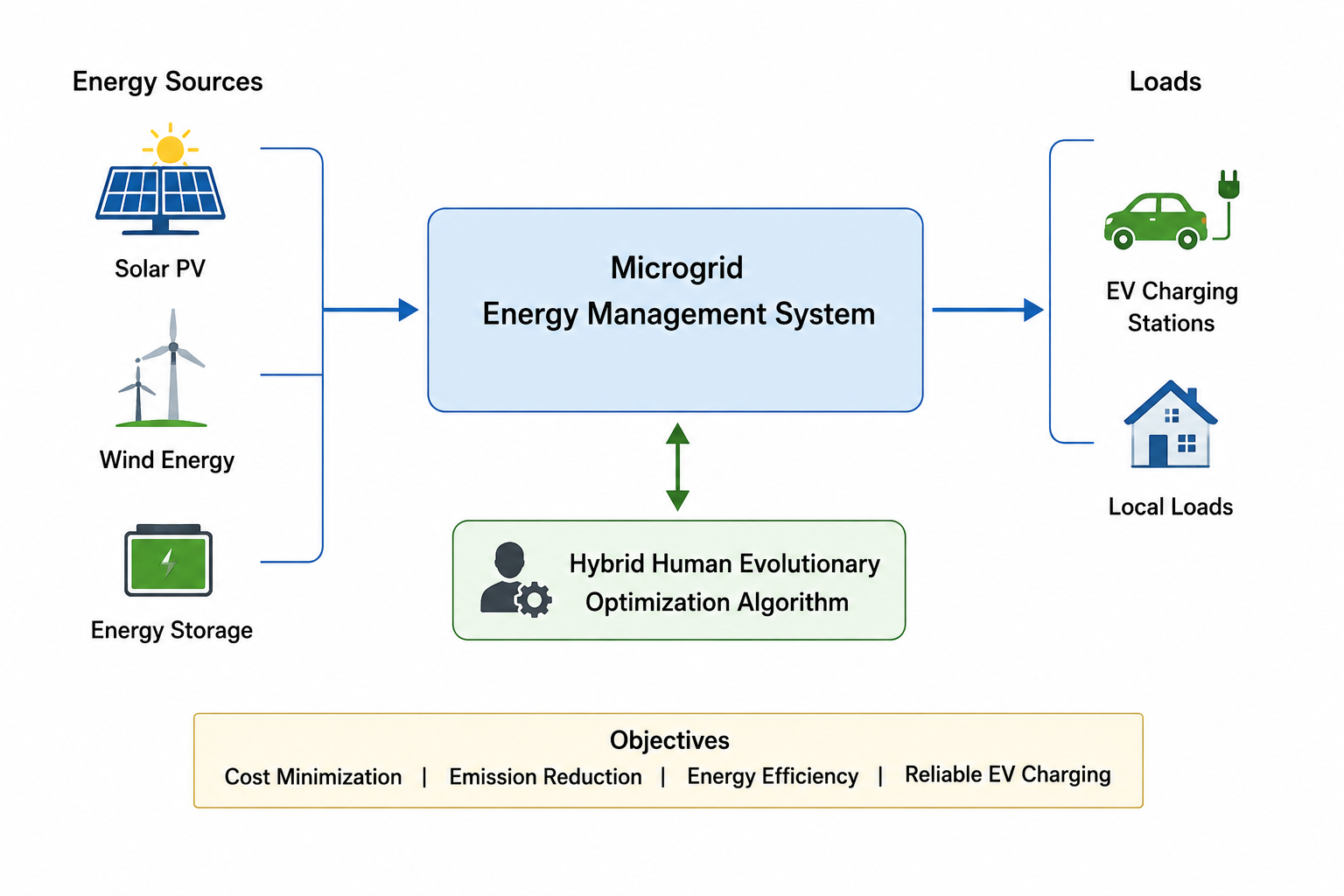
A Comprehensive Review of Energy Management in Microgrids: A Hybrid Human Evolutionary Optimization Algorithm for Grid-Isolated Electric Vehicle Charging Systems
Keywords:
Abstract
The increasing integration of renewable energy and rapid adoption of electric vehicles (EVs) require advanced energy management strategies for modern microgrids. Grid-isolated microgrids provide sustainable localized energy generation and consumption but face challenges from renewable intermittency, variable loads, and uncertain EV charging patterns. This review examines energy management systems (EMS), emphasizing hybrid human evolutionary optimization algorithms for isolated EV charging systems. Classical optimization, metaheuristic algorithms, and hybrid approaches are evaluated for cost minimization, emission reduction, energy efficiency, and reliable operation. Hybrid strategies combining human-inspired decision-making with evolutionary algorithms demonstrate improved adaptability, robustness, and management of renewable generation and EV demand uncertainties. Integration of artificial intelligence, machine learning, and demand response further enhances EMS performance. Metaheuristic techniques such as particle swarm optimization and Harris hawk optimization provide effective solutions for nonlinear and dynamic energy systems, improving energy utilization and reducing operational costs. However, computational complexity, real-time implementation, scalability, and algorithm efficiency remain significant challenges. Future research should prioritize lightweight, scalable, and adaptive optimization techniques capable of real-time operation. Hybrid AI-driven optimization frameworks are expected to support reliable EV charging, efficient renewable energy utilization, and sustainable energy management in next-generation isolated microgrids and intelligent power systems.