
Artificial Intelligence for Bandwidth-Efficient Output-Feedback Control of MEMS Gyroscopes Using Steerable Graph Neural Networks
Keywords:
MEMS Gyroscope Control
Steerable Graph Neural Networks
Output-Feedback Control
Transmission Bandwidth Constraints
Artificial Intelligence Control Systems
Inertial Navigation
Abstract
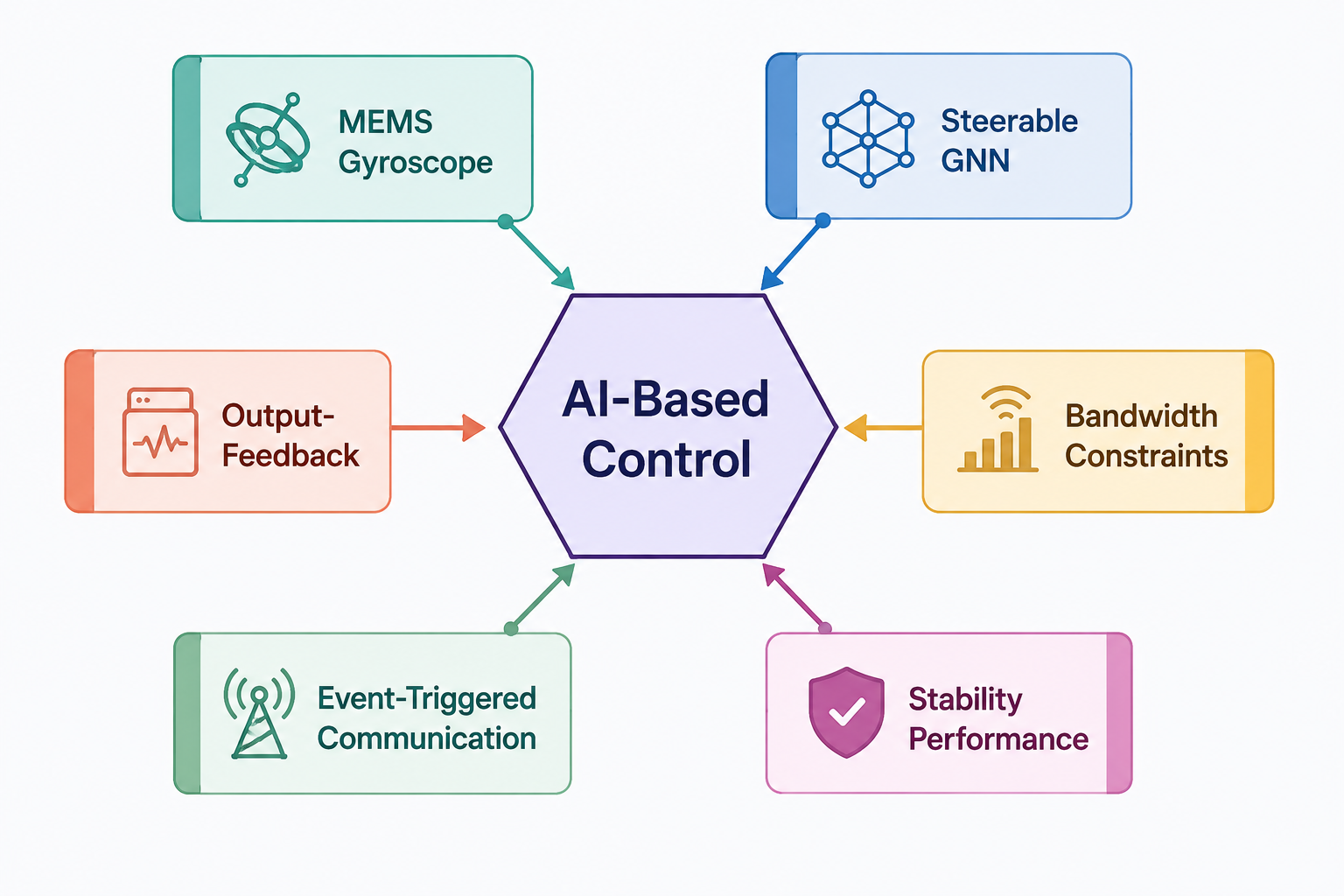
Microelectromechanical systems (MEMS) gyroscopes are essential for inertial navigation, robotics, aerospace guidance, autonomous vehicles, and consumer electronics. However, conventional model-based controllers often struggle with nonlinear dynamics, parameter uncertainties, fabrication imperfections, and quadrature errors. Artificial intelligence offers adaptive and computationally efficient alternatives for improving stability, accuracy, and robustness in embedded MEMS platforms. This review examines AI-driven constrained output-feedback control methods, emphasizing steerable graph neural networks (SGNNs) that capture relational sensor dynamics and preserve equivariance under rotational and geometric transformations. SGNN-based controllers can represent sensing-element topology, identify informative substructures, and operate when complete state information is unavailable. Their geometric learning capability supports generalization across different orientations and operating configurations without extensive retraining. Nevertheless, limited communication bandwidth in wireless sensor networks, IoT systems, and edge platforms creates additional challenges. Event-triggered communication, data compression, distributed estimation, and self-triggered protocols are therefore required to preserve control performance while reducing data transmission. The review synthesizes developments in MEMS modeling, observer-based control, graph neural networks, equivariant learning, and adaptive control. It also identifies challenges in stability assurance, computational efficiency, communication-aware learning, hardware deployment, and real-time validation for practical AI-enabled MEMS gyroscope systems.
Downloads
Published
2024-09-17
How to Cite
Somanathan, A. (2024). Artificial Intelligence for Bandwidth-Efficient Output-Feedback Control of MEMS Gyroscopes Using Steerable Graph Neural Networks. Multidisciplinary Journal of Research in Engineering and Technology, 11(2), 78–87. Retrieved from https://journals.mriindia.com/index.php/mjret/article/view/3950
Issue
Section
Articles
