Intelligent Predictive Optimization Framework for Demand Forecasting and Inventory Planning in Food Supply Chains
Keywords:
Abstract
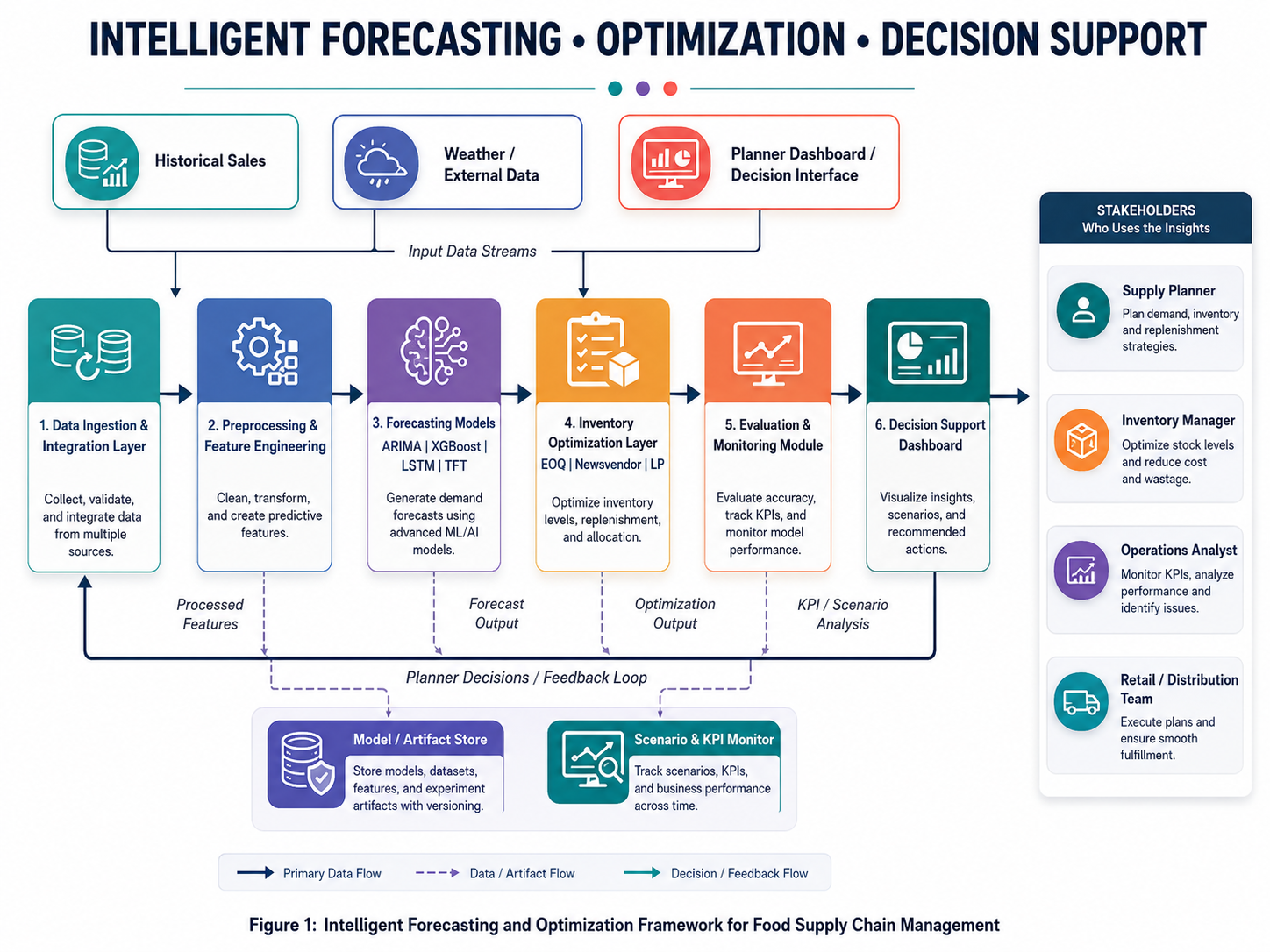
Food supply chain management is highly challenging because demand patterns change due to seasonality, weather conditions, promotions, consumer behaviour, and product perishability. Traditional forecasting methods often fail to capture these nonlinear and time-dependent variations, which may lead to inaccurate demand estimation, excess stock, stockouts, and food wastage. To address these issues, this paper presents an intelligent predictive optimization framework for demand forecasting and inventory planning in food supply chains. The proposed framework processes multi-source data, including historical sales records, weather variables, promotional information, and product-level demand trends. It applies time series and machine learning models such as ARIMA, XGBoost, Long Short-Term Memory, and Temporal Fusion Transformer to generate multi-horizon demand forecasts. These forecast outputs are then used by optimization models, including Economic Order Quantity, Newsvendor formulation, and Linear Programming, to support cost-efficient replenishment and inventory planning while maintaining required service levels. The framework also includes a decision-support dashboard that allows planners to visualize forecast trends, compare demand patterns, monitor inventory indicators, and perform scenario-based analysis. The system performance is evaluated using standard forecasting metrics such as Mean Absolute Percentage Error, Root Mean Square Error, and Bias. The proposed approach connects predictive analytics with prescriptive optimization, enabling more accurate demand planning, better stock control, reduced wastage, and improved operational efficiency. Overall, the framework provides a scalable and data-driven solution for sustainable and responsive food supply chain management.