AI-Driven Aviation Decision Support Framework for Flight Disruption Prediction and Intelligent Fare Optimization
Keywords:
Abstract
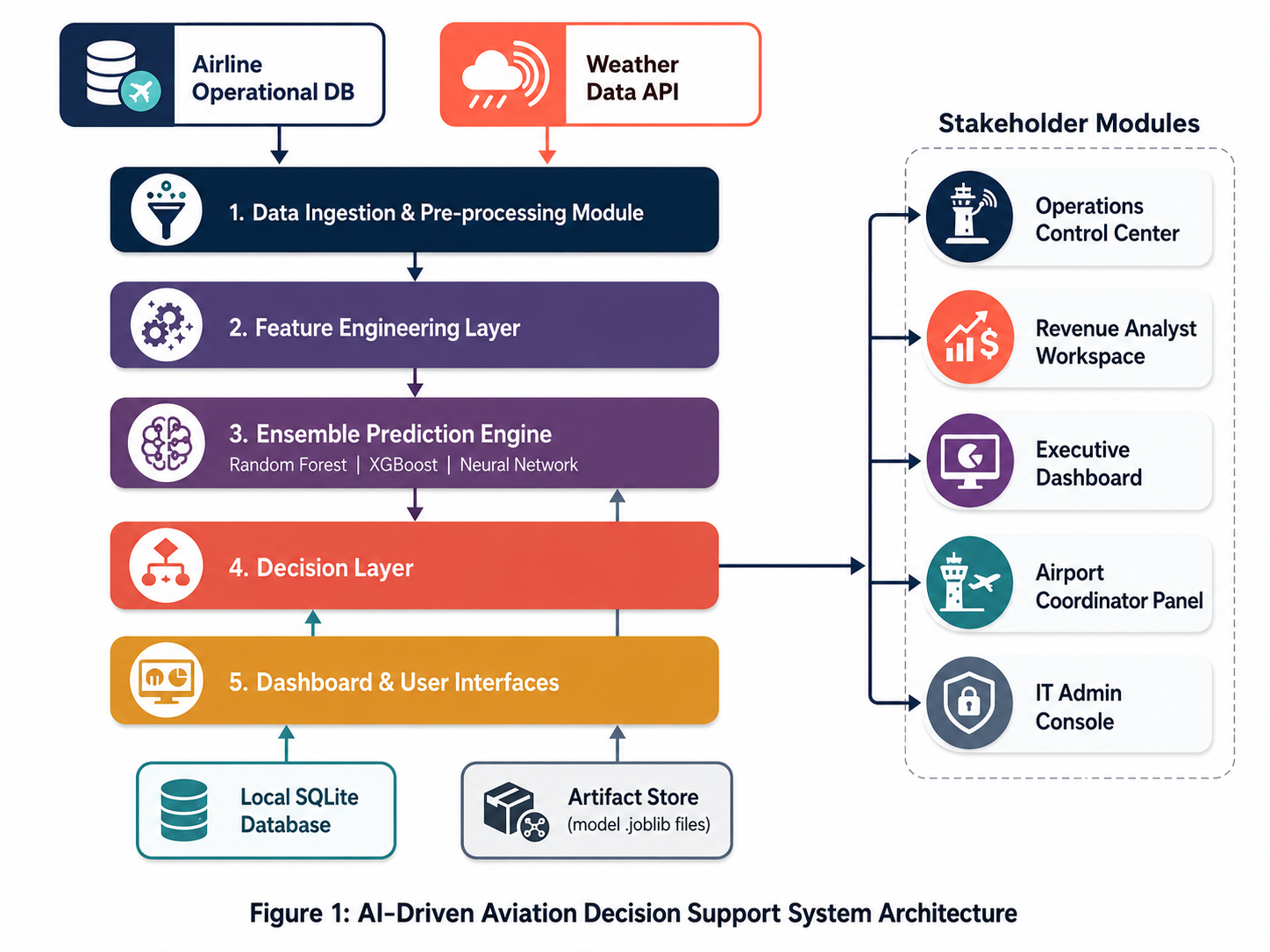
Airline operations are frequently affected by schedule disruptions caused by weather changes, air traffic congestion, airport load, and resource limitations. These disruptions lead to passenger inconvenience, operational inefficiency, and revenue loss. Most existing airline systems respond after delays occur and do not strongly connect operational delay forecasting with fare-related decision support. To address this limitation, this paper presents an AI-driven aviation decision support framework for flight disruption prediction and intelligent fare optimization. The proposed system uses an ensemble of machine learning models, including Random Forest, XGBoost, and Neural Networks, to predict delay probability and expected delay duration from flight schedule data, weather conditions, airport congestion indicators, and historical operational records. The predicted delay information is then used by a fare optimization module to adjust ticket prices dynamically within predefined limits. This helps balance passenger demand, operational uncertainty, and revenue management. The system is implemented using Python-based machine learning tools, a lightweight Streamlit dashboard, and an SQLite database for local data handling. It supports real-time inference and includes offline operation capability for up to 48 hours, making it useful in low-connectivity or unstable network environments. Experimental evaluation shows that the system achieves delay prediction accuracy of at least 85% with Mean Absolute Error within 15 minutes. The results indicate that combining predictive delay analysis, intelligent fare adjustment, dashboard-based visualization, and offline decision support can improve airline planning, reduce disruption impact, and support more efficient revenue-oriented decision-making.