Power Quality Improvement in Distribution Networks Using FACTS Devices
DOI:
https://doi.org/10.65521/itsi-teee.v5i1.4255Keywords:
Abstract
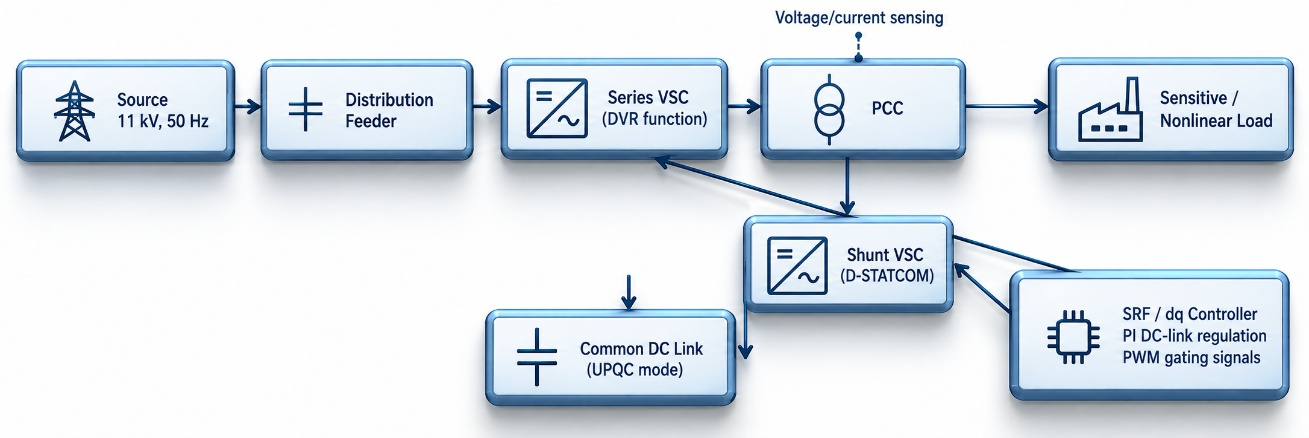
Modern distribution networks increasingly supply nonlinear, unbalanced, and electronically controlled loads, making voltage sag, voltage swell, harmonic distortion, poor power factor, and load unbalance important power-quality concerns. This methodology paper develops a comparative framework for improving distribution-system power quality using Flexible AC Transmission System (FACTS)-derived custom-power devices, with emphasis on the Distribution Static Compensator (D-STATCOM), Dynamic Voltage Restorer (DVR), and Unified Power Quality Conditioner (UPQC). A three-phase 11-kV, 50-Hz distribution feeder is modeled with a nonlinear rectifier load and variable reactive demand. Disturbances are introduced through programmed voltage sag/swell events and nonlinear current injection. The D-STATCOM is configured for shunt reactive-current and harmonic compensation, the DVR for series voltage restoration, and the UPQC for coordinated series-shunt compensation through a common dc link. Synchronous-reference-frame transformation, proportional-integral dc-link regulation, and pulse-width modulation are adopted as the common control basis. Performance is assessed using load-voltage magnitude, source-current total harmonic distortion (THD), voltage THD, power factor, dc-link stability, and disturbance-recovery time. Literature available up to 2016 shows that converter-based compensators provide faster and more versatile mitigation than conventional passive compensation, while UPQC offers the broadest simultaneous correction of voltage- and current-related disturbances. The proposed methodology is suitable for MATLAB/Simulink or PSCAD implementation and provides a reproducible basis for comparing device capability, rating, and control complexity in radial distribution networks.