A Survey of Methods and Architectures for An Optimized Dynamic Deep Unfold Network Model for Predicting Cardiac Arrhythmias Based On 12 Lead ECG Signals
DOI:
https://doi.org/10.65521/itsi-teee.v13i1.3842Keywords:
Abstract
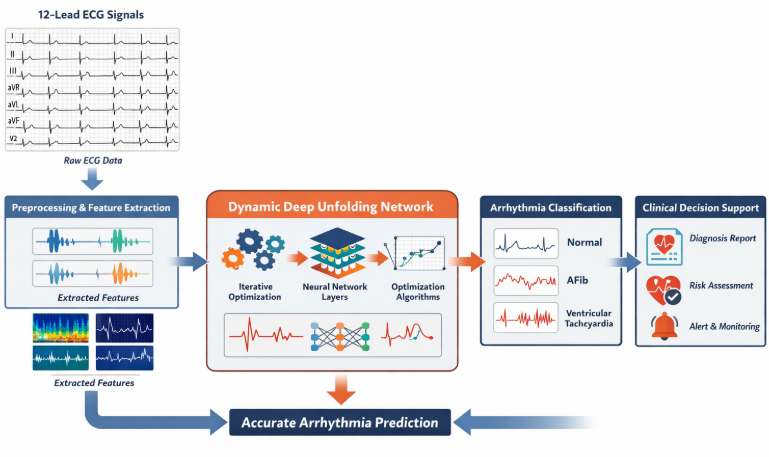
Cardiac arrhythmias represent a major global health concern due to their association with increased morbidity and mortality. The analysis of 12-lead electrocardiogram (ECG) signals has become a cornerstone for accurate diagnosis, yet manual interpretation remains time-consuming and prone to variability. Recent advancements in artificial intelligence, particularly deep learning, have significantly improved automated arrhythmia detection. Among these, dynamic deep unfolding networks have emerged as a promising paradigm, combining model-based optimization with data-driven learning to enhance interpretability and performance. This survey presents a comprehensive review of methods and architectures employed for arrhythmia prediction using 12-lead ECG signals, with a focus on optimized dynamic deep unfolding approaches. It examines traditional machine learning techniques, convolutional and recurrent neural networks, hybrid architectures, and optimization strategies integrated within unfolding frameworks. The paper also highlights key challenges such as data imbalance, noise robustness, computational efficiency, and clinical generalization. Furthermore, emerging trends including explainable AI, transfer learning, and real-time monitoring systems are discussed. By synthesizing recent developments, this survey aims to provide insights into the design of efficient and reliable arrhythmia prediction systems, guiding future research toward clinically viable solutions.