Comparative Analysis of Routing Protocols in Wireless Communication Networks
DOI:
https://doi.org/10.65521/itsi-teee.v7i1.4233Keywords:
Abstract
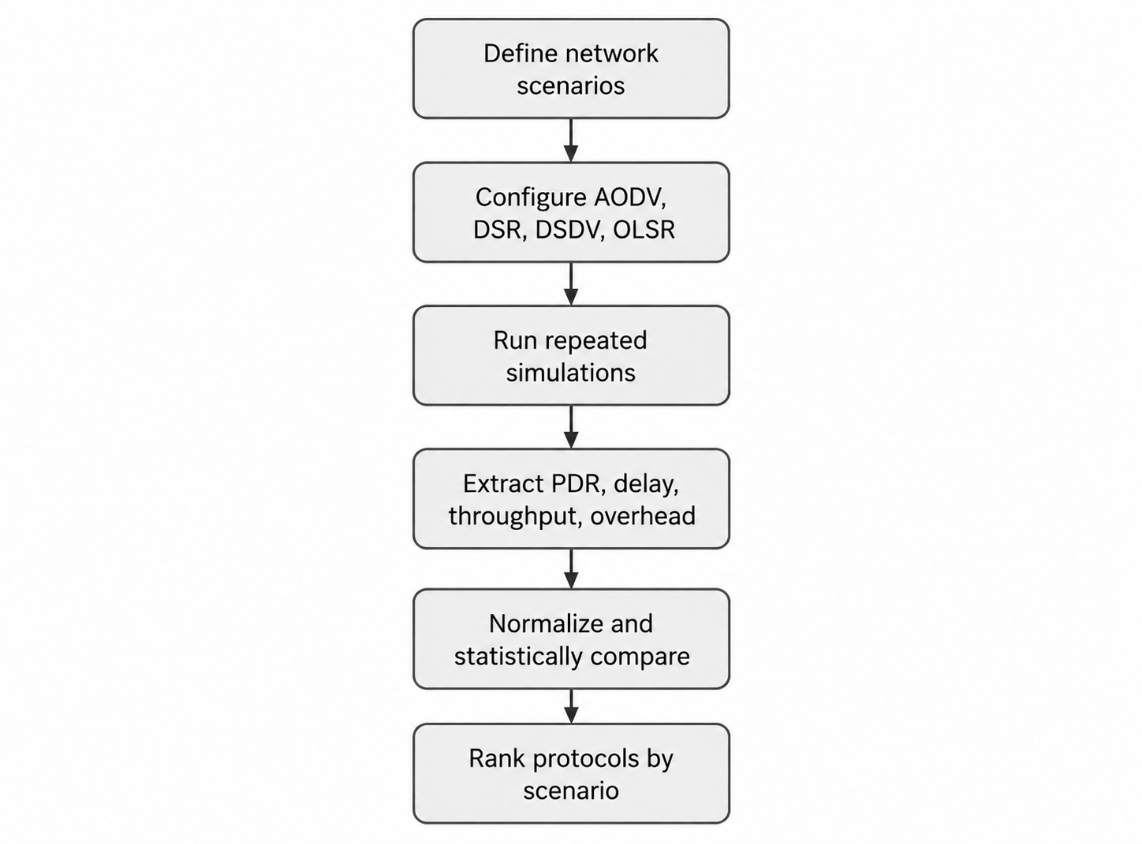
Routing is a fundamental function in wireless multi-hop communication because every node may need to forward packets on behalf of other nodes while links change because of mobility, interference, congestion, or limited transmission range. This methodology paper develops a controlled framework for comparing four widely used routing approaches: Ad Hoc On-Demand Distance Vector (AODV), Dynamic Source Routing (DSR), Destination-Sequenced Distance Vector (DSDV), and Optimized Link State Routing (OLSR). The comparison is designed around reproducible packet-level simulation rather than isolated protocol descriptions. Network size, node mobility, offered traffic, and pause time are varied systematically while the physical and medium-access settings are held constant. Packet delivery ratio, throughput, average end-to-end delay, normalized routing load, and energy consumed per successfully delivered packet are treated as the principal response variables. Multiple random seeds and confidence intervals are proposed to reduce dependence on a single mobility trace. The expected outcome is not a universally superior protocol, but a scenario-dependent decision rule: proactive protocols are expected to provide lower route-acquisition delay in relatively stable or dense networks, whereas reactive protocols are expected to reduce periodic control cost when traffic is intermittent or topology changes frequently. The framework also incorporates an energy and quality-of-service perspective consistent with later MANET research. The paper therefore provides a compact and repeatable methodology for selecting routing protocols for wireless ad hoc, emergency, tactical, sensor-assisted, and Internet-of-Things communication environments.