Artificial Intelligence Techniques for Automatic Cervical Cancer Detection and Segmentation Using Sparsity-Aware Orthogonal Initialization in Deep Neural Network Classifiers: Trends and Challenges
DOI:
https://doi.org/10.65521/itsi-teee.v13i1.3849Keywords:
Abstract
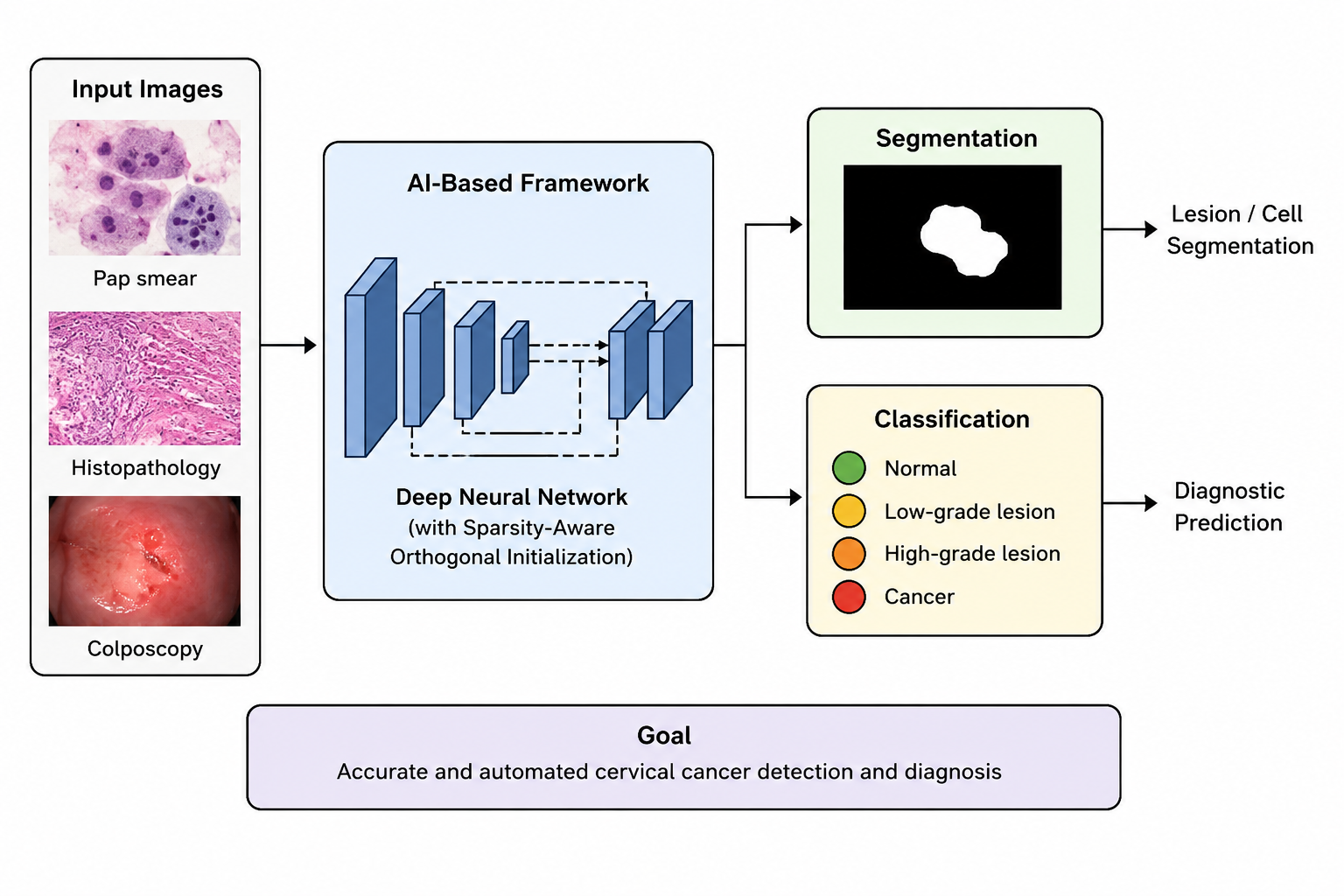
Cervical cancer remains one of the leading causes of cancer-related mortality among women worldwide, particularly in low-resource regions where access to effective screening and expert diagnosis is limited. Recent advances in artificial intelligence (AI), especially deep learning, have significantly improved the automation of cervical cancer detection and segmentation using Pap smear, colposcopy, and histopathological images. This review examines recent developments in AI-based diagnostic systems, with particular emphasis on deep neural network classifiers incorporating sparsity-aware orthogonal initialization. Advanced architectures such as convolutional neural networks (CNNs), U-Net variants, and hybrid CNN–Transformer models have achieved high accuracy by effectively extracting hierarchical and spatial image features. Sparsity-aware orthogonal initialization enhances training stability by preserving signal propagation, accelerating convergence, and reducing parameter redundancy, thereby improving overall model performance. The review highlights research trends, including attention mechanisms, transfer learning, and data augmentation techniques that enhance segmentation and classification accuracy. It also discusses persistent challenges such as limited annotated datasets, class imbalance, computational complexity, and insufficient model interpretability. Finally, the study identifies future research directions, including explainable AI, lightweight deep learning models for real-time clinical deployment, and multimodal data integration, to support accurate early diagnosis and reduce cervical cancer mortality.