Fault Detection and Protection of Transmission Lines Using Digital Relays
DOI:
https://doi.org/10.65521/itsi-teee.v7i1.4229Keywords:
Abstract
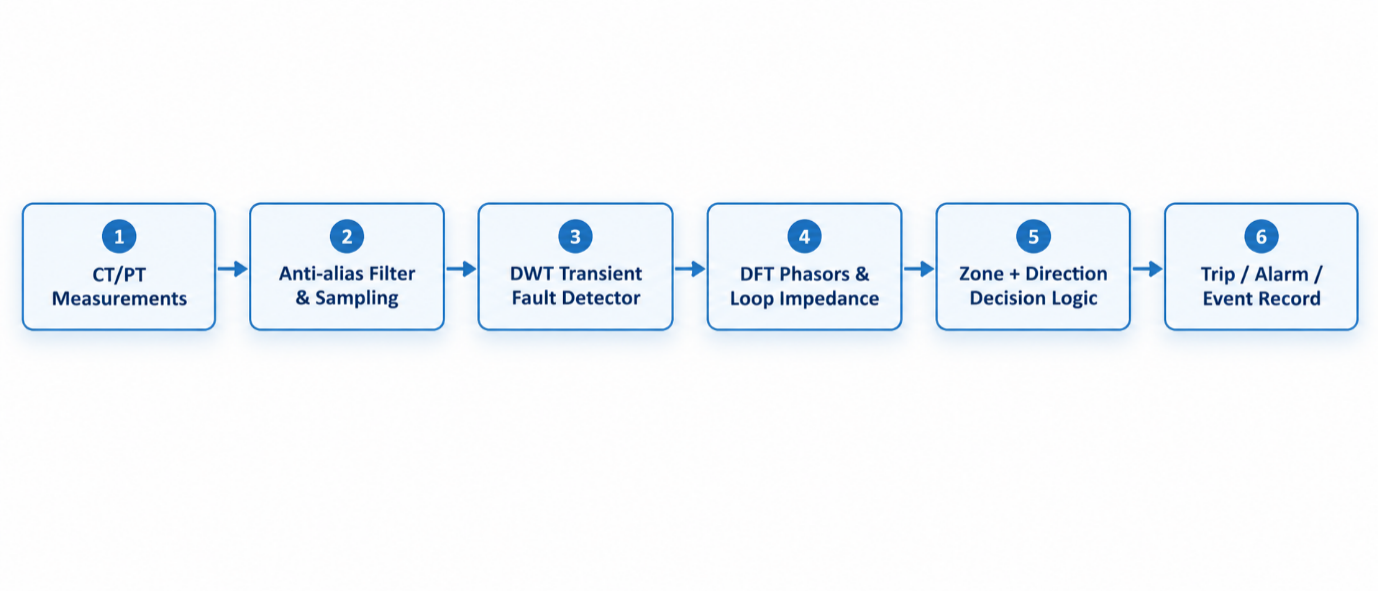
Reliable transmission-line protection requires rapid fault recognition, correct phase selection, directional security, and selective circuit-breaker tripping. This methodology paper proposes a digital relay framework that combines transient detection with conventional distance-protection logic. Three-phase voltage and current signals are acquired through current and voltage transformers, filtered, sampled, and processed in a digital relay. A discrete wavelet transform (DWT) detects the abrupt high-frequency change associated with fault inception, while a one-cycle discrete Fourier transform (DFT) estimates fundamental-frequency phasors for loop-impedance calculation. Ground and phase loops are evaluated against three distance zones, with directional supervision and a persistence check used to prevent reverse-fault or noise-driven operation. The study is organized around a 220 kV, 100 km transmission-line model and a systematic test matrix containing single-line-to-ground, line-to-line, double-line-to-ground, and three-phase faults at multiple locations, inception angles, and fault resistances. Representative numerical validation indicates that low- and moderate-resistance internal faults can be detected in less than one cycle, while the impedance element provides selective zone discrimination and location estimates typically within 2% of line length. The methodology is intended as a reproducible basis for MATLAB/Simulink, PSCAD, or real-time digital simulator implementation and emphasizes coordination between fast transient detection and dependable impedance-based tripping.