Deep Transfer Learning and Hybrid Texture Feature Analysis for Melanoma Skin Cancer Classification
DOI:
https://doi.org/10.65521/itsi-teee.v14i2.2860Keywords:
Abstract
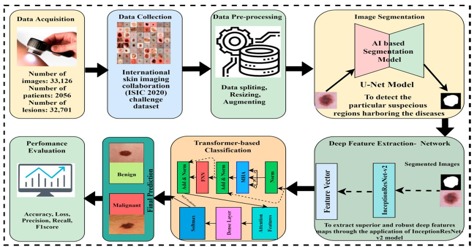
Melanoma skin cancer remains one of the most aggressive and life-threatening forms of skin malignancies, necessitating early and accurate detection for effective treatment. Recent advancements in medical image processing have leveraged deep learning and transfer learning architectures to significantly enhance diagnostic performance. This review paper presents a comprehensive analysis of deep learning-based transfer learning approaches integrated with optimization strategies and hybrid texture feature extraction techniques for melanoma detection and classification. The study emphasizes the role of convolutional neural networks, pretrained architectures, and feature fusion mechanisms in improving classification accuracy while addressing challenges such as limited annotated datasets and high inter-class similarity. Additionally, optimization techniques, including hyperparameter tuning, metaheuristic algorithms, and feature selection methods, are explored to enhance model generalization and computational efficiency. Hybrid texture features derived from dermoscopic images, including color, shape, and spatial characteristics, are discussed in relation to their contribution toward robust feature representation. The paper systematically reviews existing literature, identifies research gaps, and highlights emerging trends in artificial intelligence-driven melanoma diagnosis. The findings indicate that combining transfer learning with hybrid feature engineering and optimization strategies leads to superior diagnostic accuracy and reliability. This review aims to provide valuable insights for researchers and practitioners working in the domain of medical image analysis and intelligent healthcare systems.