A Comprehensive Review of Deep Learning Techniques for Stroke Detection Using CT Brain Neuroimages
DOI:
https://doi.org/10.65521/ijtarme.v15i1.4743Keywords:
Abstract
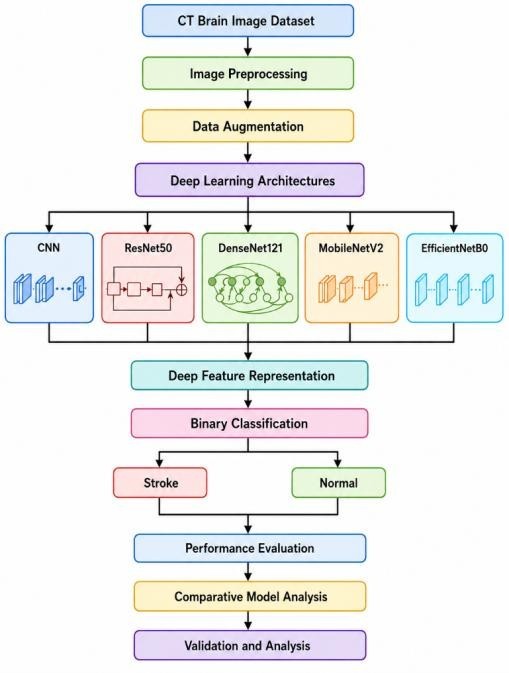
Stroke is one of the main causes of death and long-term disability worldwide. How well a patient recovers often depends on how quickly the diagnosis is made. The first test that doctors usually order is a contrast CT scan of the human head. It is fast and available in every hospital. Reading the scan correctly is not so simple. During a shift a radiologist often misses the early signs of stroke, such as faint spots and small changes, in contrast. That’s where deep learning, a part of intelligence comes in. It can help automate parts of the reading. In this paper we check some deep learning methods that are used to detect stroke using CT brain images. We have to foucus on a convolutional neural network (CNN) and on four important architectures: ResNet, DenseNet, MobileNet and EfficientNet. The CNN is central, to my study. Provides the foundation for all these architectures. We compare how well each model learns, how computing power they need and how useful they are in real medical settings. So we built a framework that separates CT brain images into two groups Stroke and Normal. Each model CNN, ResNet50, DenseNet121, MobileNetV2, and EfficientNetB0 is trained individually. Then we compare their performance side by side. The process includes preprocessing the images using data augmentation applying transfer learning evaluating the models and finally deploying them with Streamlit. Finally, we cover the open challenges in this area. There are still some issues and challenges, in this area. We also discuss that how future research can or will make AI-based stroke detection more free from error or mistake.