Comparative Performance and Emission Assessment of Biodiesel–Diesel Blends in a Direct-Injection Diesel Engine
DOI:
https://doi.org/10.65521/ijtarme.v11i1.4422Keywords:
Abstract
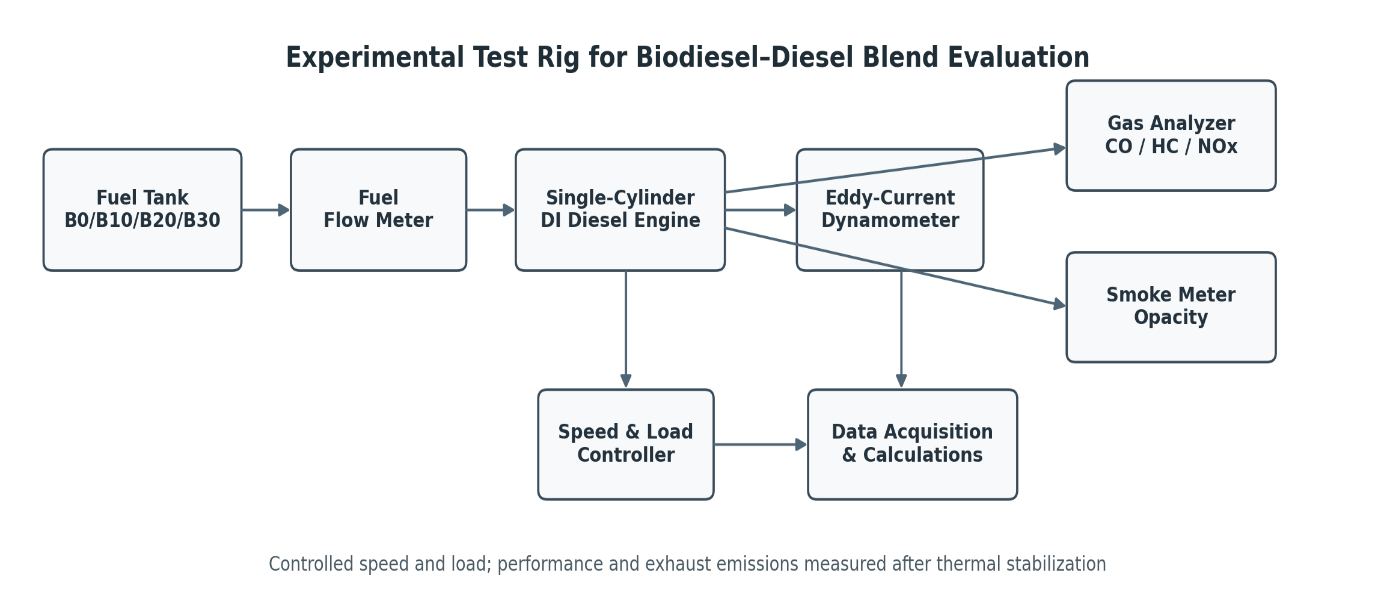
The use of biodiesel–diesel blends in compression-ignition engines provides a practical approach for reducing petroleum dependence and selected exhaust emissions while retaining conventional engine hardware. This study presents a controlled experimental methodology for comparing the performance and emission behavior of B0, B10, B20, and B30 fuels in a single-cylinder, four-stroke direct-injection diesel engine operated at a constant speed of 1500 rpm under variable load. Fuel properties are characterized before testing, and measurements are obtained at 0, 25, 50, 75, and 100% engine load after thermal stabilization. The evaluation includes brake thermal efficiency, brake-specific fuel consumption, carbon monoxide, unburned hydrocarbons, nitrogen oxides, and smoke opacity. Each operating condition is repeated to improve reliability, and blend and load effects are assessed using statistical analysis. The representative full-load results indicate that increasing biodiesel concentration causes a modest reduction in brake thermal efficiency and an increase in brake-specific fuel consumption, while CO, HC, and smoke emissions decrease progressively. Relative to B0, the illustrative B20 condition reduces CO by approximately 26%, HC by about 17%, and smoke opacity by around 16%, while NOx increases from 1220 to 1290 ppm. Brake thermal efficiency changes from 31.8% for B0 to 31.2% for B20, with BSFC increasing from 0.268 to 0.279 kg/kWh. Among the investigated blends, B20 provides the most balanced compromise between performance retention and reduction of incomplete-combustion emissions. The proposed methodology offers a reproducible framework for evaluating biodiesel blend suitability under controlled diesel-engine operating conditions.