Performance and Emission Analysis of Biodiesel-Fueled Compression Ignition Engines
DOI:
https://doi.org/10.65521/ijtarme.v9i1.4414Keywords:
Abstract
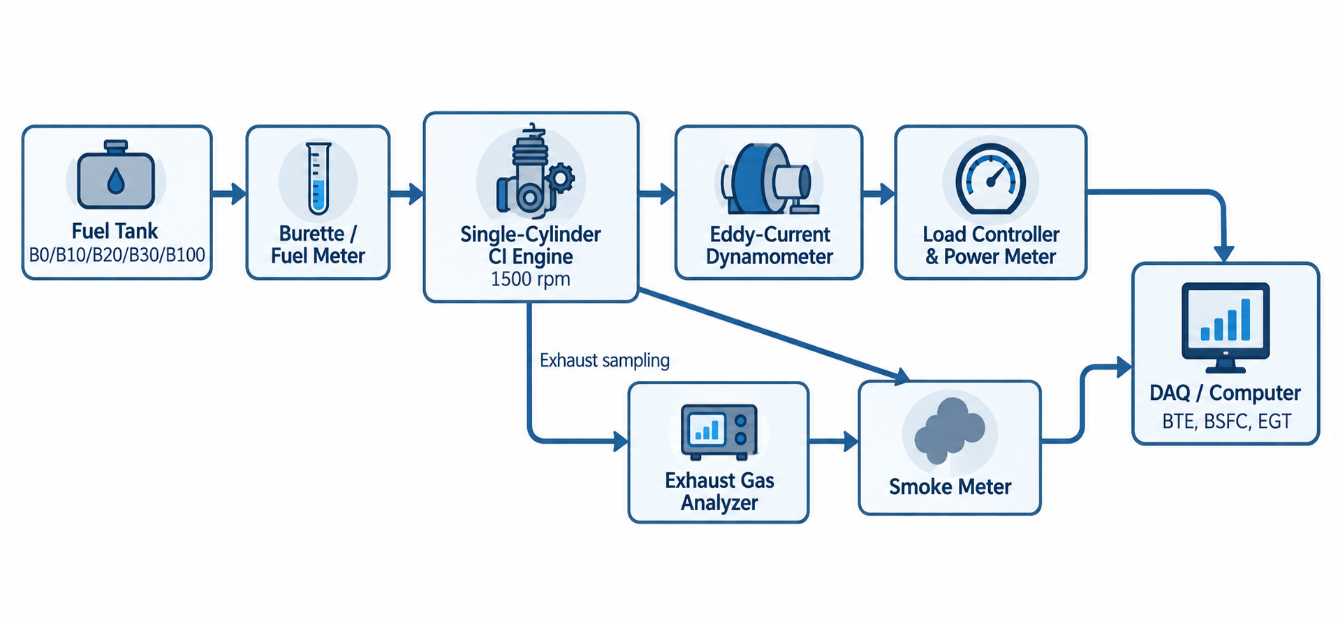
Biodiesel is a renewable oxygenated fuel that can be used in compression ignition (CI) engines either in neat form or as a blend with petroleum diesel. This paper presents a compact experimental methodology for evaluating the performance and exhaust-emission behavior of a single-cylinder CI engine operated with diesel (B0) and biodiesel blends B10, B20, B30 and B100. The proposed tests are conducted at a constant speed of 1500 rpm over 0–100% load. Brake thermal efficiency (BTE), brake-specific fuel consumption (BSFC) and exhaust gas temperature (EGT) are used as performance indicators, while carbon monoxide (CO), unburned hydrocarbons (HC), oxides of nitrogen (NOx) and smoke opacity are used as emission indicators. The methodology includes fuel-property measurement, instrument calibration, repeated steady-state testing and uncertainty estimation. Literature through 2020 consistently indicates that increasing biodiesel fraction tends to reduce CO, HC and smoke because of fuel-bound oxygen, but may increase BSFC because of lower heating value and can increase NOx depending on combustion temperature and injection behavior. Representative results included for method demonstration show B20 as a practical compromise between efficiency and emission reduction. These values are illustrative and should be replaced by measured data when the experiment is performed.