Performance Evaluation of Hybrid Solar Air Heating Systems for Industrial Drying Applications
DOI:
https://doi.org/10.65521/ijtarme.v10i1.4421Keywords:
Abstract
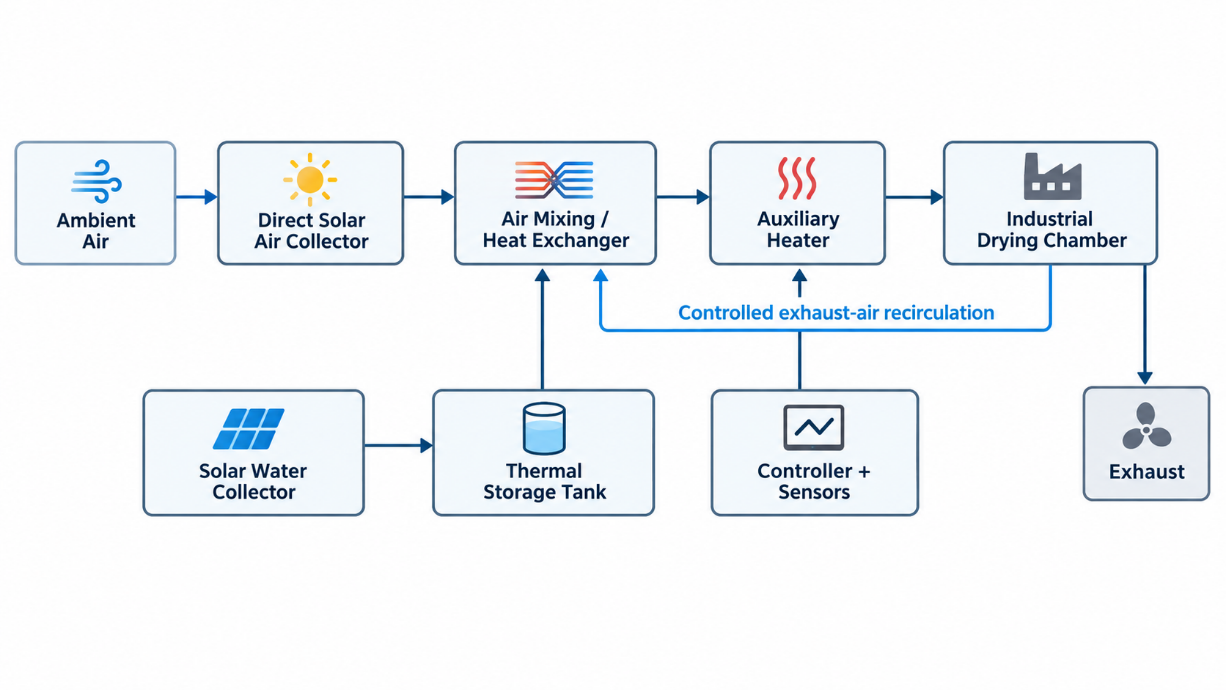
Industrial drying is a major consumer of low- and medium-temperature process heat, while conventional fuel-fired and electrical dryers are exposed to high operating cost and greenhouse-gas emissions. This methodology paper develops a structured performance-evaluation framework for a hybrid solar air-heating system intended for industrial drying. The proposed configuration combines a direct flat-plate solar air-heater field, an indirect solar-water loop coupled to thermal storage and an air heat exchanger, a controllable auxiliary heater, and partial exhaust-air recirculation. The evaluation uses energy balances, collector efficiency, solar fraction, drying efficiency, specific energy consumption, specific moisture extraction rate, temperature stability, and drying time as performance indicators. A representative pilot-industrial design case with an 80 m2 collector field, 1.0 kg/s process-air flow rate, 55 degC drying set point, and a 500 kg wet-product batch is used to demonstrate the method. Model-based results indicate that hybrid operation can maintain a more stable drying temperature than solar-only operation, reduce specific energy consumption relative to conventional auxiliary heating, and provide a useful solar contribution without sacrificing process continuity. The methodology is intended as a repeatable basis for comparing hybrid solar drying configurations before plant-scale investment and experimental validation