Optimization of Additive Manufacturing Parameters for Improved Mechanical Properties of Polymer Components
DOI:
https://doi.org/10.65521/ijtarme.v10i1.4418Keywords:
Abstract
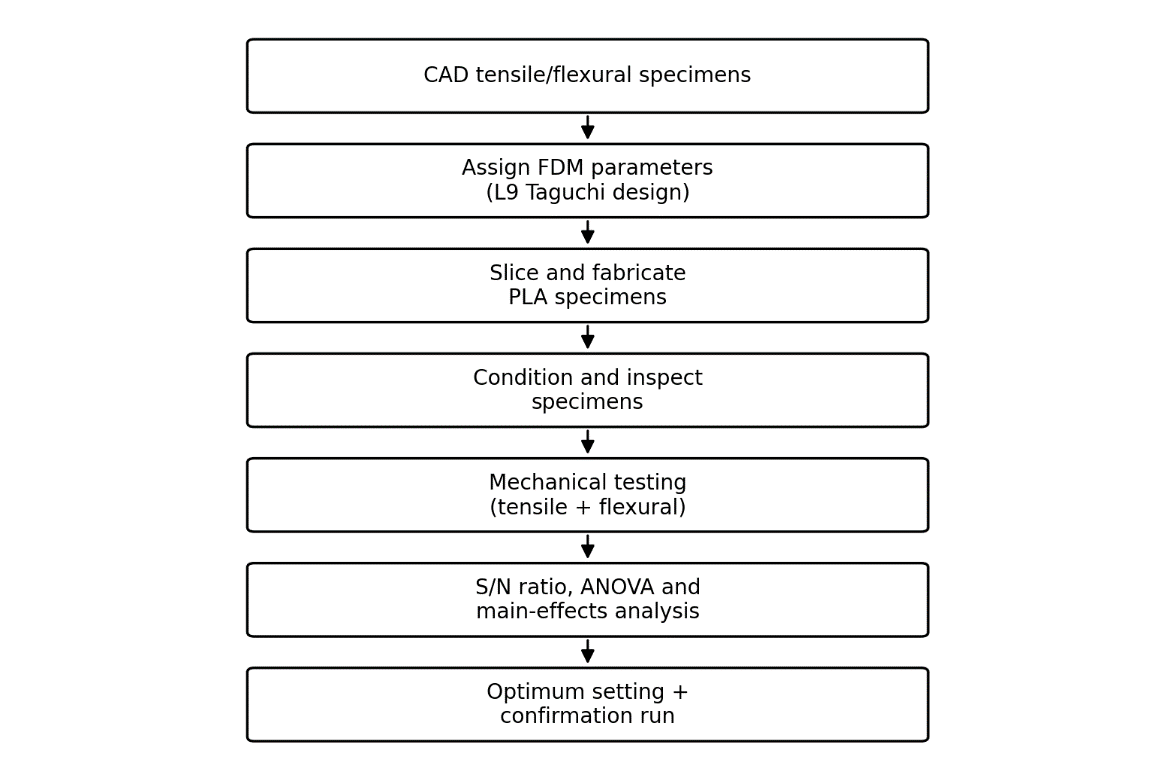
Material-extrusion additive manufacturing is increasingly used to produce functional polymer components, but the mechanical performance of printed parts remains strongly dependent on process settings and the layer-wise architecture. This methodology paper develops a compact design-of-experiments framework for optimizing fused deposition modelling/fused filament fabrication (FDM/FFF) parameters for polylactic acid (PLA) components. Four controllable factors—layer thickness, infill density, raster angle and nozzle temperature—are arranged in a Taguchi L9 orthogonal array. Tensile strength and flexural strength are selected as primary responses, with print time retained as a practical secondary response. The proposed workflow combines standardized specimen fabrication, mechanical testing, signal-to-noise analysis, analysis of variance (ANOVA), regression and a confirmation run. Literature up to 2021 shows that lower layer thickness, favorable filament alignment, greater infill and adequate extrusion temperature generally strengthen inter-road and interlayer bonding. To demonstrate the analysis procedure without claiming unperformed laboratory measurements, a literature-bounded numerical dataset is included. The demonstration identifies a low layer thickness, high infill, load-aligned raster and moderate nozzle temperature as the strongest setting, with an estimated tensile-strength improvement of approximately 20% relative to a mid-level baseline. The framework is suitable for later experimental validation and can be extended to ABS, PETG, nylon and reinforced thermoplastics.