Experimental Investigation of Heat Transfer Enhancement Using Nanofluids in Compact Heat Exchangers
DOI:
https://doi.org/10.65521/ijtarme.v9i1.4416Keywords:
Abstract
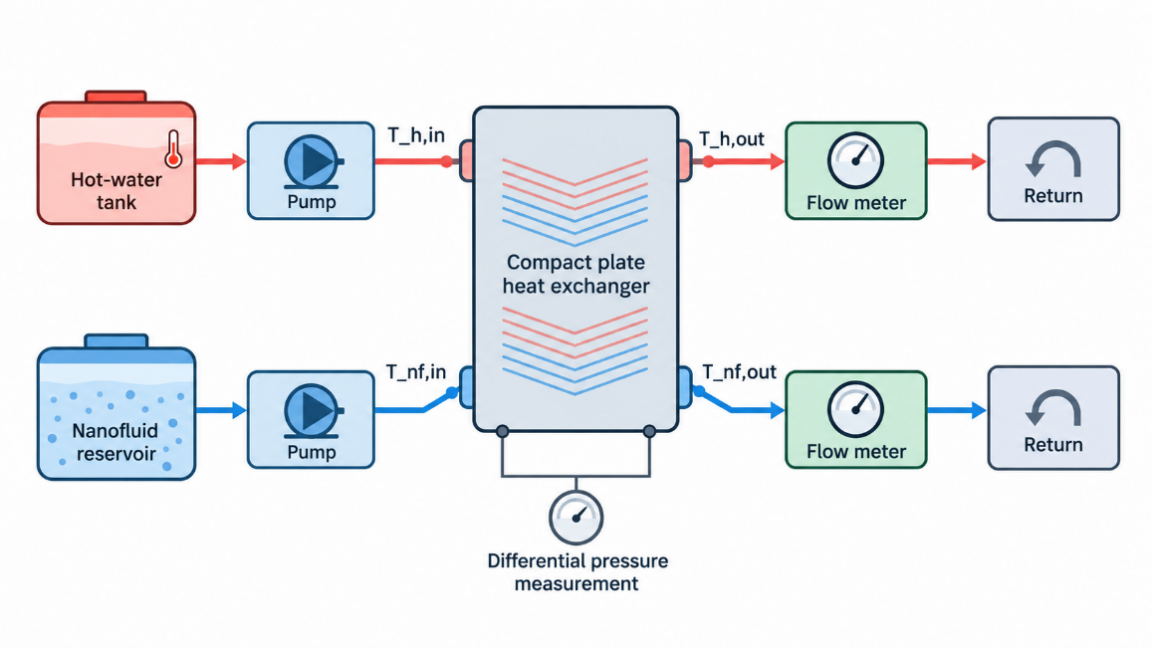
Compact heat exchangers provide high heat-transfer-area density, but their performance is constrained by the limited thermal conductivity of conventional working fluids. This methodology paper develops an experimental framework to quantify heat-transfer enhancement and hydraulic penalties when low-concentration Al2O3/water nanofluids are circulated through a compact corrugated plate heat exchanger. A two-loop counter-flow rig is proposed with independently controlled inlet temperatures, variable flow rate, calibrated thermocouples, flow meters, and differential-pressure measurement. Nanofluids at 0.05, 0.10, and 0.20 vol.% are prepared by a two-step dispersion method and compared with deionized water over Reynolds numbers of approximately 2500-7000. Performance is evaluated using heat duty, overall and convective heat-transfer coefficients, Nusselt number, pressure drop, effectiveness, and a thermal-hydraulic performance index. Representative methodology data indicate that increasing particle loading raises the convective coefficient by about 4-13% while producing a pressure-drop penalty below about 10% at the highest concentration. The proposed procedure therefore captures the central engineering trade-off: nanoparticle addition can improve compact heat-exchanger thermal performance, but concentration and flow rate must be optimized to avoid excessive pumping power. The framework is suitable for laboratory validation and for comparing nanofluid formulations under controlled operating conditions.