Optimization of Cutting Parameters in CNC Turning for Improved Surface Roughness and Tool Life
DOI:
https://doi.org/10.65521/ijtarme.v7i1.4398Keywords:
Abstract
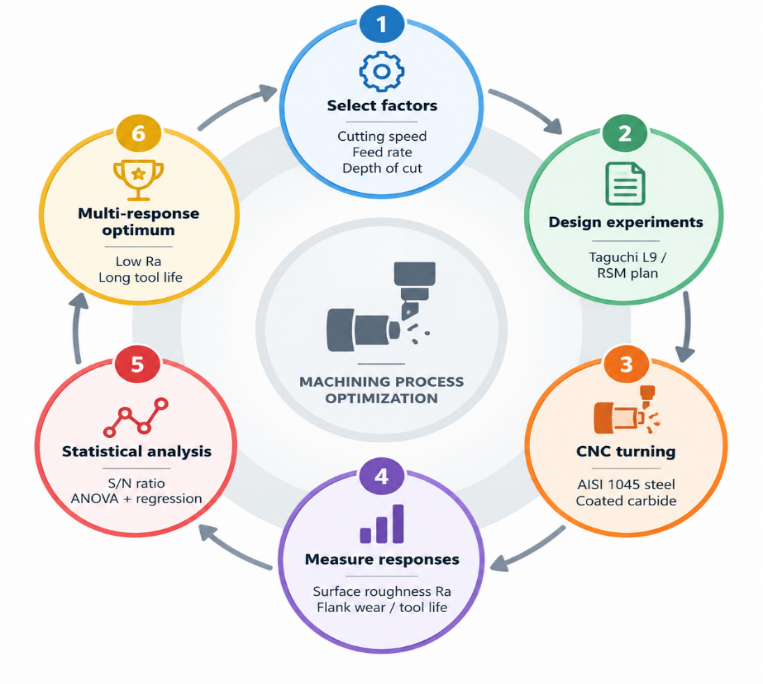
This methodology paper presents a structured experimental and statistical framework for optimizing the principal cutting parameters in computer numerical control (CNC) turning with the dual objective of minimizing surface roughness and extending cutting-tool life. Cutting speed, feed rate and depth of cut are treated as controllable factors, while arithmetic average surface roughness (Ra) and flank-wear-based tool life are treated as performance responses. A three-level Taguchi L9 design is proposed for screening and economical experimentation, followed by analysis of variance (ANOVA), regression/response surface modeling and multi-response desirability optimization. The procedure uses AISI 1045 steel and a coated carbide insert as a representative workpiece-tool combination. Surface roughness is measured using a stylus profilometer, while flank wear is monitored at fixed cutting intervals and tool life is defined at a limiting average flank wear of 0.30 mm. The methodology explicitly separates roughness control from wear control because low feed generally benefits surface finish, whereas excessive cutting speed can shorten tool life. Literature up to 2018 confirms that feed often dominates roughness; while cutting speed, tool condition and cooling regime strongly influence wear and tool life. The representative data reported here are included only to demonstrate the analysis workflow; they are not claimed as an independently executed laboratory campaign. The framework is intended to support repeatable parameter selection, confirmation testing and industrial transfer of optimized CNC turning conditions.