
A Hybrid Deep Learning Approach for Enhancing Cybersecurity Threat Detection in Cloud Computing Environments
DOI:
https://doi.org/10.65521/intjournalrecadvengtech.v15i2.4752Keywords:
Abstract
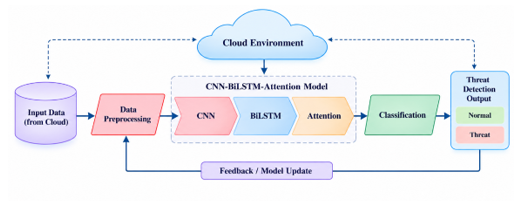
The widespread adoption of cloud computing has introduced significant cybersecurity challenges associated with distributed infrastructure, virtualization, multi-tenant resource sharing, and rapidly evolving network attacks. Conventional intrusion detection systems frequently rely on predefined signatures and static detection mechanisms, which may limit their ability to identify sophisticated and previously unseen malicious activities. This paper proposes a hybrid deep learning approach integrating Convolutional Neural Networks (CNN) and Bidirectional Long Short-Term Memory (BiLSTM) networks with an attention mechanism for intelligent cybersecurity threat detection in cloud computing environments. The proposed architecture combines convolution-based spatial feature extraction, bidirectional sequential learning, and attention-based feature weighting to identify complex patterns associated with malicious network traffic. A structured preprocessing mechanism incorporating data normalization, class imbalance handling, feature selection, and temporal sequence construction is designed to improve the reliability of predictive analysis. The framework is formulated for evaluation using publicly available network intrusion detection datasets, including CICIDS2017 and UNSW-NB15. The proposed evaluation methodology compares the hybrid approach with conventional machine learning algorithms and individual deep learning architectures using accuracy, precision, recall, F1-score, false positive rate, and computational efficiency. Recent literature published establishes the relevance of hybrid learning methods for contemporary intrusion detection applications. The study presents a modular cybersecurity detection architecture and a reproducible experimental methodology for examining its effectiveness in cloud-oriented network security. Experimental implementation and independent validation are necessary to establish the model's actual detection performance and practical suitability.
Downloads
Downloads
Published
How to Cite
Issue
Section
License

This work is licensed under a Creative Commons Attribution-NoDerivatives 4.0 International License.
