
Finite Element Analysis of Composite Materials for Lightweight Automotive Components
Keywords:
Abstract
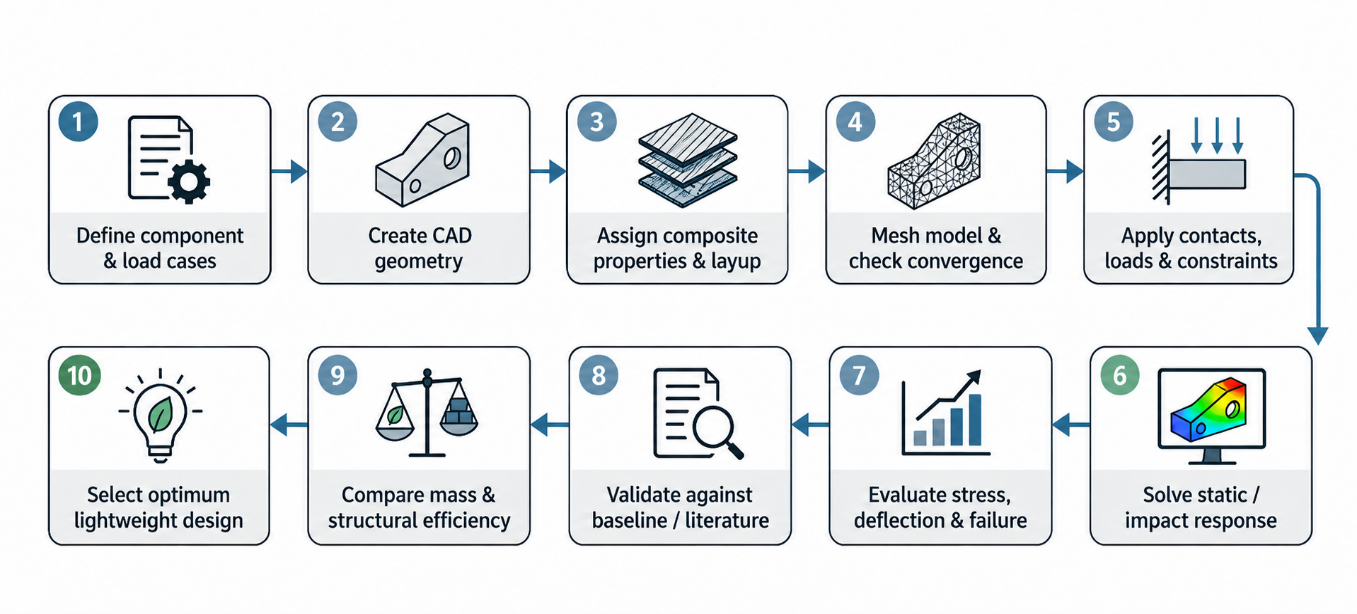
Automotive lightweighting is a major engineering strategy for improving fuel economy, reducing emissions, and maintaining crash safety. Fiber-reinforced polymer composites offer high specific stiffness and strength, but their anisotropic behavior, progressive damage, and sensitivity to ply orientation require analysis methods that are more detailed than those commonly used for isotropic metals. This methodology paper presents a finite element analysis (FEA) framework for evaluating composite materials in lightweight automotive components. The proposed procedure considers geometry idealization, orthotropic material definition, laminate layup, mesh convergence, boundary conditions, contact, static and impact loading, and composite failure assessment. A conventional steel component is used as the baseline and is compared with carbon-fiber-reinforced polymer (CFRP), glass-fiber-reinforced polymer (GFRP), and a natural-fiber composite configuration. Hashin-type failure indices and stress/deflection measures are incorporated to identify critical failure modes, while mass and structural efficiency are used as lightweighting metrics. Representative numerical outputs show how a carefully designed CFRP laminate can provide substantial mass reduction while controlling deformation and failure index, whereas natural-fiber composites are more suitable where moderate loads and sustainability objectives dominate. The methodology is intended as a repeatable workflow that can be implemented in commercial FEA software and validated against published automotive composite studies available up to 2016.
Downloads
Downloads
Published
How to Cite
Issue
Section
License

This work is licensed under a Creative Commons Attribution-NoDerivatives 4.0 International License.
