
Comparative Study of Renewable Energy Integration Techniques in Modern Power Distribution Systems
Keywords:
Abstract
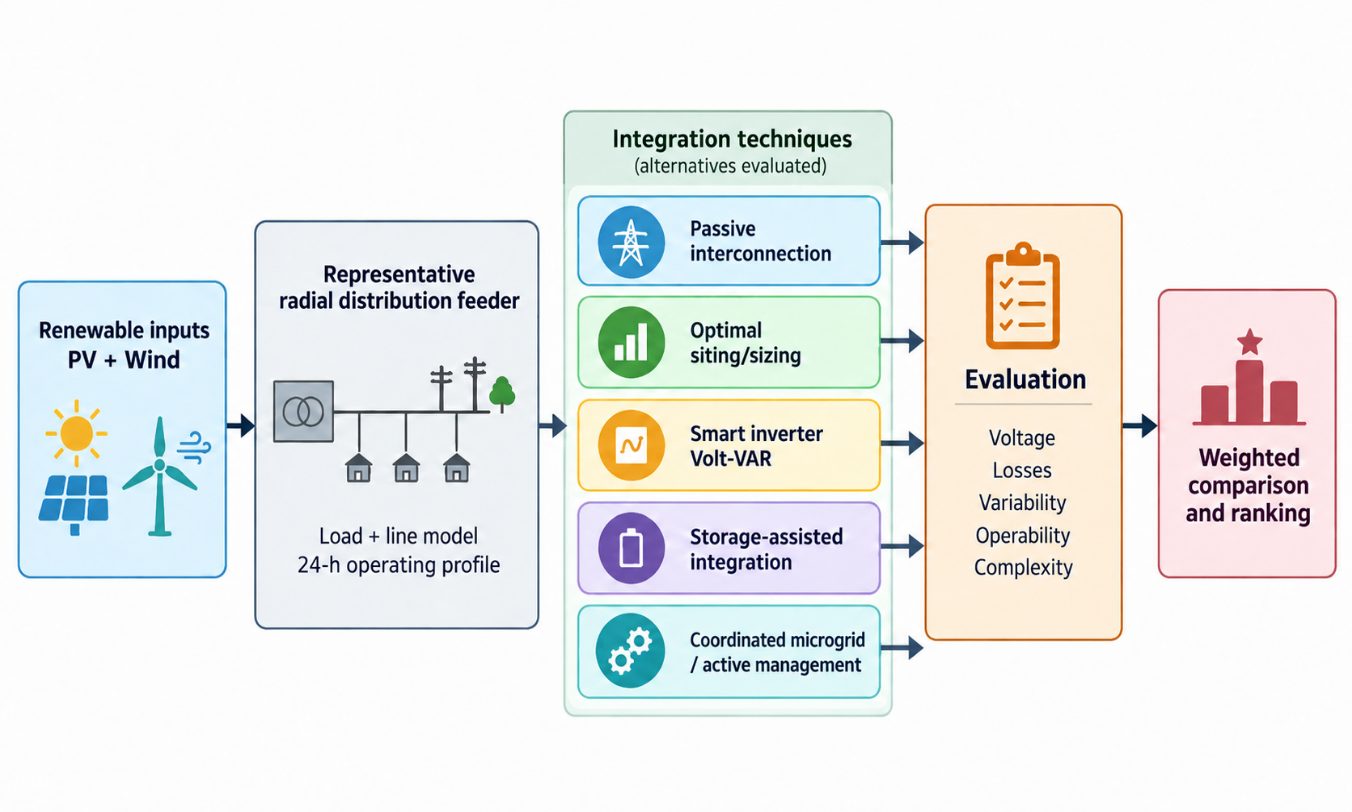
The rapid penetration of photovoltaic (PV) and wind generation is transforming distribution networks from passive, one-directional systems into active networks with bidirectional power flow. This methodology paper develops a structured framework for comparing five renewable-energy integration techniques: conventional passive interconnection, optimal siting and sizing of distributed generation, smart-inverter Volt-VAR control, storage-assisted integration, and coordinated microgrid/active network management. The comparison is designed around a representative radial distribution feeder evaluated over a 24-hour load and renewable-generation cycle. Common performance indicators include voltage regulation, feeder losses, renewable variability mitigation, operational and protection compatibility, and implementation complexity. The literature base is restricted to peer-reviewed work published no later than 2015. Rather than reporting unverified field measurements, the Results section applies a transparent ordinal scoring rubric supported by the reviewed literature. The comparison indicates that passive interconnection is suitable only at modest penetration levels, optimal siting improves losses and voltage performance, smart-inverter control is effective for local voltage management, energy storage is strongest for variability mitigation, and coordinated microgrid or active-network control provides the most comprehensive technical performance but at greater cost and control complexity. The proposed framework can be reproduced in tools such as MATLAB/Simulink, OpenDSS, PSCAD, or DIgSILENT PowerFactory for feeder-specific validation.
Downloads
Downloads
Published
How to Cite
Issue
Section
License

This work is licensed under a Creative Commons Attribution-NoDerivatives 4.0 International License.
