
Artificial Intelligence Techniques for Hybrid Graph Neural Networks for Wearable IoT Monitoring Systems with Adaptive Algorithms and Energy-Efficient WSN Integration: Trends and Challenges
DOI:
https://doi.org/10.65521/intjournalrecadvengtech.v14i2.2589Keywords:
Abstract
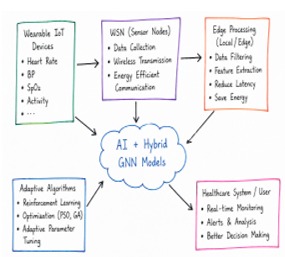
The convergence of artificial intelligence (AI), Graph Neural Networks (GNNs), and wearable Internet of Things (IoT) technologies has significantly advanced modern healthcare monitoring systems. These systems enable real-time analysis of physiological signals through interconnected sensor networks, providing improved diagnosis, anomaly detection, and personalized healthcare services. However, challenges related to scalability, energy consumption, computational complexity, and data heterogeneity persist. This review explores artificial intelligence techniques applied to hybrid GNN-based wearable IoT monitoring systems integrated with adaptive algorithms and energy-efficient Wireless Sensor Networks (WSNs). The study analyses key AI-driven models, including Graph Convolutional Networks (GCNs), Graph Attention Networks (GATs), and spatio-temporal GNNs, along with optimization techniques such as reinforcement learning, evolutionary algorithms, and federated learning. Additionally, energy-efficient WSN integration is examined to enhance system sustainability. Comparative insights reveal that hybrid AI-GNN frameworks significantly improve predictive accuracy and system adaptability. However, computational overhead and energy constraints remain major challenges. The paper concludes by discussing emerging trends such as edge intelligence, explainable AI, and graph-based anomaly detection, highlighting future research directions for scalable and efficient wearable healthcare systems.
Downloads
Downloads
Published
How to Cite
Issue
Section
License

This work is licensed under a Creative Commons Attribution-NoDerivatives 4.0 International License.
