
A Survey of Methods and Architectures for Efficient Hybrid Ladybug Beetle Optimization and Physics-Informed Neural Networks for Electric Vehicle Energy Management
DOI:
https://doi.org/10.65521/intjournalrecadvengtech.v14i1.2566Keywords:
Abstract
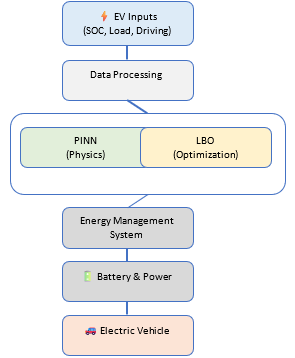
Electric vehicles (EVs) have emerged as a sustainable alternative to conventional transportation systems, necessitating efficient energy management strategies to enhance battery performance, driving range, and system reliability. Recently, hybrid artificial intelligence techniques combining metaheuristic optimization algorithms and deep learning frameworks have gained significant attention. In particular, Physics-Informed Neural Networks (PINNs) integrate physical laws into neural network training, enabling accurate modelling of EV dynamics while reducing dependency on large datasets. Simultaneously, nature-inspired optimization algorithms such as Ladybug Beetle Optimization (LBO) offer efficient global search capabilities for solving complex nonlinear optimization problems. This paper presents a comprehensive survey of hybrid approaches that integrate LBO with PINNs for EV energy management systems (EMS). The study explores recent advancements in intelligent control strategies, battery management, and energy optimization techniques. It highlights how hybrid frameworks enhance system efficiency, reduce computational complexity, and improve prediction accuracy. Furthermore, the paper discusses challenges such as real-time implementation, scalability, and data limitations. A comparative analysis of recent studies is provided to evaluate the effectiveness of different methodologies. The findings indicate that hybrid AI-based EMS architectures significantly outperform traditional rule-based and model-based approaches, paving the way for next-generation intelligent EV systems.
Downloads
Downloads
Published
How to Cite
Issue
Section
License

This work is licensed under a Creative Commons Attribution-NoDerivatives 4.0 International License.
