
An Automated Retrieval-Augmented Generation Framework for Course Generation
DOI:
https://doi.org/10.65521/intjournalrecadvengtech.v14i3s.1661Keywords:
Abstract
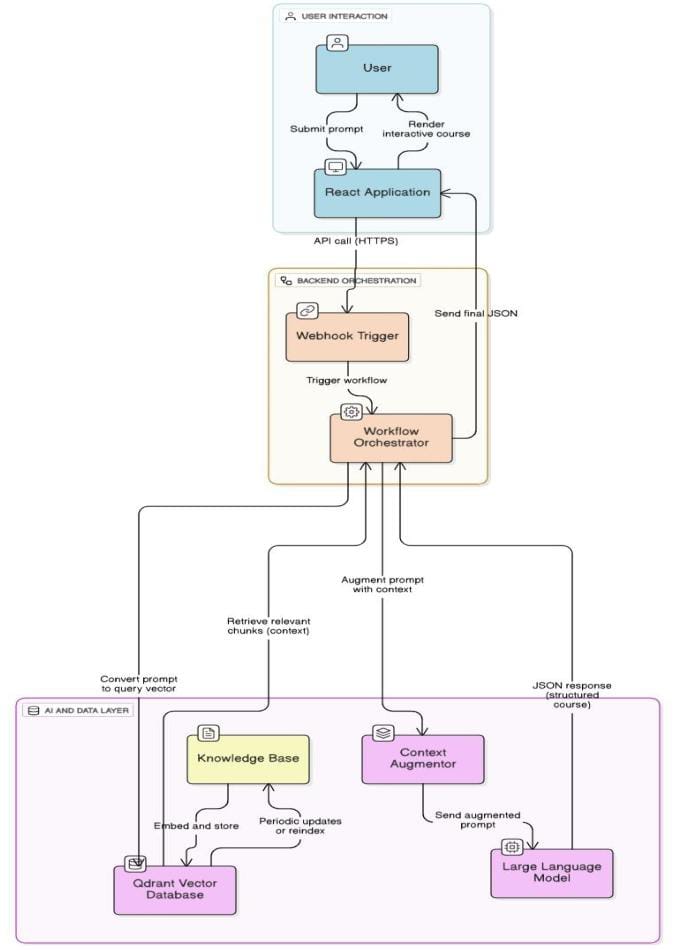
This paper presents an automated framework for course generation designed to address critical inefficiencies in traditional curriculum development. The creation of high-quality educational content is a resource-intensive process that impedes the rapid deployment of customized learning materials in academic and corporate environments. Our proposed system overcomes these challenges through a web-based platform that generates complete, interactive online courses from a single natural language prompt. The architecture leverages a React frontend to capture user requirements and the n8n workflow automation platform to orchestrate a sophisticated backend process.
At the core of the framework is a Retrieval-Augmented Generation (RAG) model. Upon receiving a prompt, the system employs a Large Language Model, such as Google Gemini, to first retrieve relevant information from a specified knowledge base and then generate a comprehensive course structure in a standardized JSON format. This output includes pedagogically sequenced modules, detailed lessons, multimedia placeholders, and formative assessments. RAG architecture ensures the generated content is factually grounded in trusted source materials, mitigating the risk of inaccuracies common in standalone language models.
The resulting JSON is dynamically rendered by the React application into an engaging learning interface. This automated approach offers significant advantages over traditional methods by reducing development time from weeks to minutes, enabling unparalleled scalability and personalization for diverse audiences. The framework facilitates a paradigm shift from rigid, one-size-fits-all instruction to a more flexible, on-demand, and interactive educational experience.
Downloads
Downloads
Published
How to Cite
Issue
Section
License

This work is licensed under a Creative Commons Attribution-NoDerivatives 4.0 International License.
