Finite Element Analysis of Composite Leaf Springs for Automotive Applications
Keywords:
Abstract
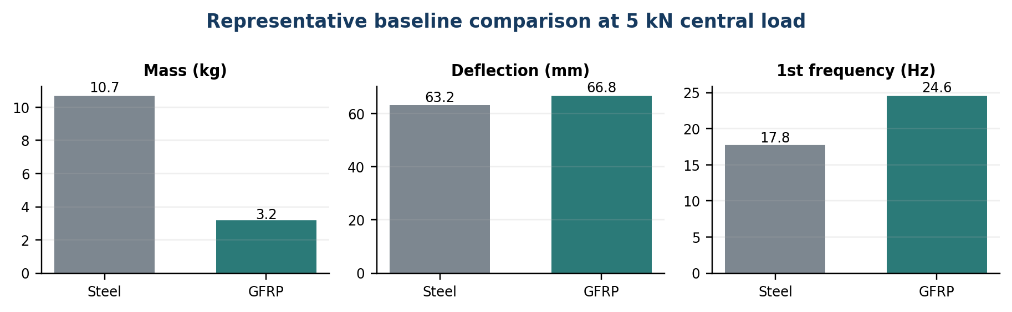
This paper presents a reproducible finite element methodology for evaluating a unidirectional E-glass/epoxy composite mono-leaf spring as a lightweight replacement for an automotive steel leaf spring. The workflow integrates requirement definition, equivalent-stiffness sizing, laminate property assignment, mesh convergence, contact and boundary-condition modelling, static strength assessment, modal analysis, fatigue screening and experimental validation planning. Orthotropic elasticity is used for the composite, while failure is assessed with maximum-stress and Tsai-Wu indices rather than an isotropic von Mises criterion. A representative 1000 mm span spring under a 5 kN central load is used to demonstrate reporting. The illustrative model predicts a mass reduction from 10.7 to 3.2 kg (70.1%), comparable vertical compliance, and an increase in first natural frequency from 17.8 to 24.6 Hz; the maximum composite failure index remains below unity. These numerical values are methodological demonstration results, not claims of completed physical testing. The proposed sequence provides traceable acceptance gates for stiffness, strength, resonance avoidance and durability, and it emphasizes eye-end stress concentration and laminate/manufacturing uncertainty as critical design risks.