Design and Fabrication of an Autonomous Line Following Robot for Industrial Applications
Keywords:
Abstract
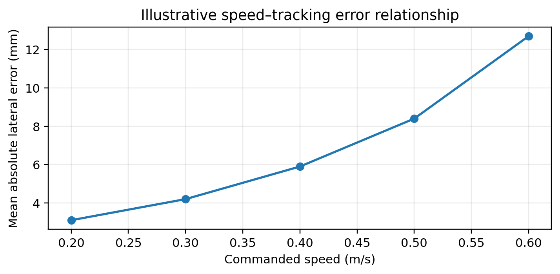
This methodology paper presents a compact design and fabrication framework for an autonomous line-following robot intended for repetitive material-transfer and guided-mobility tasks in industrial environments. The proposed platform uses a differential-drive chassis, a multi-element infrared reflectance sensor array, a microcontroller-based closed-loop controller, and pulse-width-modulated motor actuation. The control objective is to minimize lateral displacement between the robot centerline and a high-contrast floor guide while maintaining stable forward motion through straight segments, bends, and junctions. A proportional-integral-derivative (PID) correction law is adopted because it provides a practical compromise between computational simplicity, tracking accuracy, and real-time implementation on low-cost embedded hardware. The methodology covers mechanical fabrication, sensor placement, signal normalization, weighted line-position estimation, PID tuning, motor command generation, obstacle-stop logic, and a repeatable validation protocol. Earlier studies show that sensor configuration, calibration, curvature estimation, and controller selection strongly influence line-following accuracy and robustness [4], [6], [8], [9]. For industrial relevance, the proposed design also considers payload stability, battery endurance, fail-safe stopping, and repeatability. Because no user-supplied physical measurements are available, the results section provides clearly identified illustrative validation targets rather than claiming unobserved experimental data. The framework can be directly used to fabricate a laboratory prototype and then replace the illustrative values with measured test results.