Additive Manufacturing and 3D Printing Applications in Modern Mechanical Engineering
Keywords:
Abstract
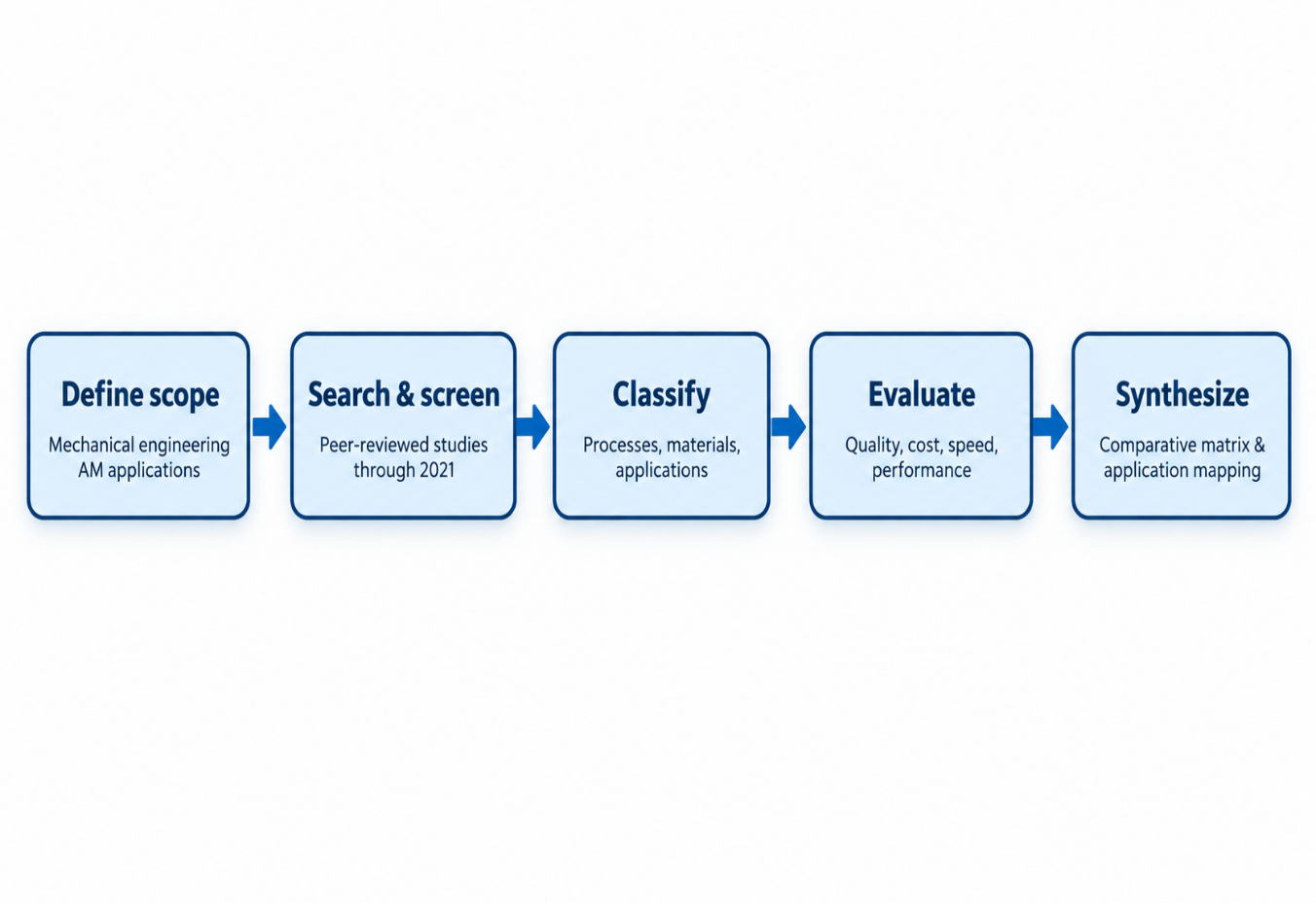
Additive manufacturing (AM), commonly called 3D printing, has evolved from a rapid-prototyping tool into a manufacturing route for functional polymer, composite, metallic, and ceramic components. This methodology paper develops a structured framework for evaluating AM applications in modern mechanical engineering using peer-reviewed literature published up to 2021. The method combines process classification, material–process compatibility analysis, application mapping, and a qualitative multi-criteria evaluation based on geometric freedom, mechanical performance, dimensional capability, build productivity, post-processing burden, and cost. Seven process families—material extrusion, vat photopolymerization, polymer powder-bed fusion, laser powder-bed fusion, electron-beam powder-bed fusion, directed-energy deposition, and binder jetting—are assessed for prototyping, tooling, lightweight structures, repair, thermal-fluid components, and low-volume customized production. The synthesis shows that no single AM route is universally superior: polymer extrusion remains effective for economical prototypes and fixtures, powder-bed fusion offers the strongest balance for complex functional parts, and directed-energy deposition is particularly attractive for repair and large metal features. The study also identifies persistent barriers including anisotropy, porosity, residual stress, surface roughness, repeatability, qualification, and post-processing. The proposed step-by-step methodology can support process selection and research planning where experimental facilities are limited and a transparent literature-based decision framework is required.