Autonomous Defect Detection System for High-Speed Assembly Lines
DOI:
https://doi.org/10.65521/ijmer.v15i1.4742Keywords:
Abstract
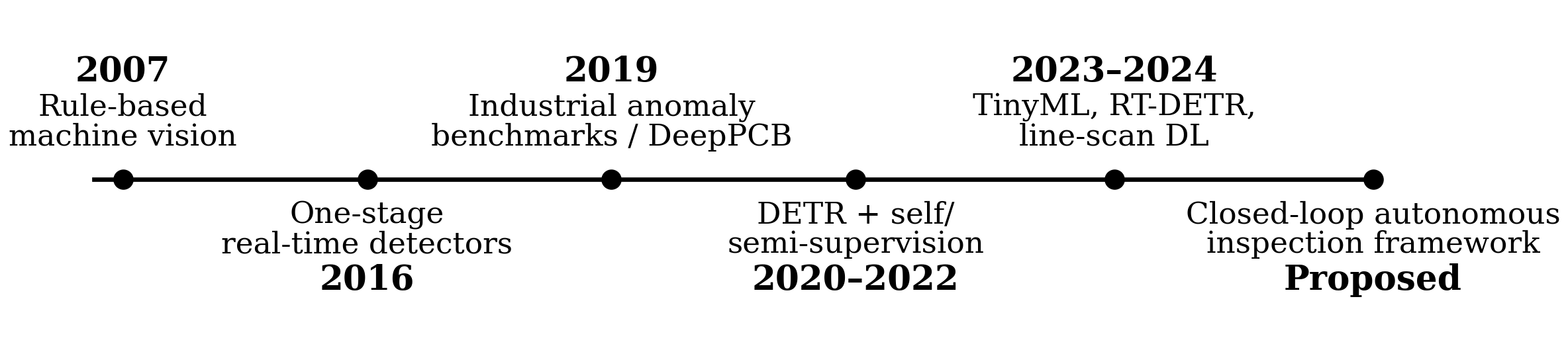
Inspection systems for high speed assembly lines need precision, low latency, robustness to sparse defect examples and traceability at the production-event level. Current state of the art in industrial vision only addresses one layer of this problem, i.e. imaging, detector accuracy, anomaly modeling or embedded inference. This paper presents an integrated autonomous visual-inspection system combining triggered picture acquisition and photometric standardization with an RT-DETR detection core, synthetic minority-defect augmentation, confidence-aware accept/reject logic and a permanent quality-trace layer. We contextualize the contribution through a research-trace analysis over rule-based machine vision, one-stage CNN detectors, industrial anomaly detection, DETR-family end-to-end detection and modern line-scan deep-learning systems. We establish a design model that relates conveyor speed, sampling density, end-to-end latency, false-accept risk and computing cost . Experimental measurements at the project scale are not yet available, so the paper does not claim any fabricated performance but defines a reproducible evaluation protocol and analytically benchmarks the design choices against published evidence such as RT-DETR, DeepPCB, MVTec-based anomaly methods, TinyML quality inspection and line-scan inspection studies. The resulting design is a technically testable architecture for high-speed electronics and discrete-part production, where detection, rejection, logging and model monitoring are performed as one closed loop.