Computational Investigation of Molecular Interactions in Novel Pharmaceutical Compounds
DOI:
https://doi.org/10.65521/ijaeee.v11i1.4614Keywords:
Abstract
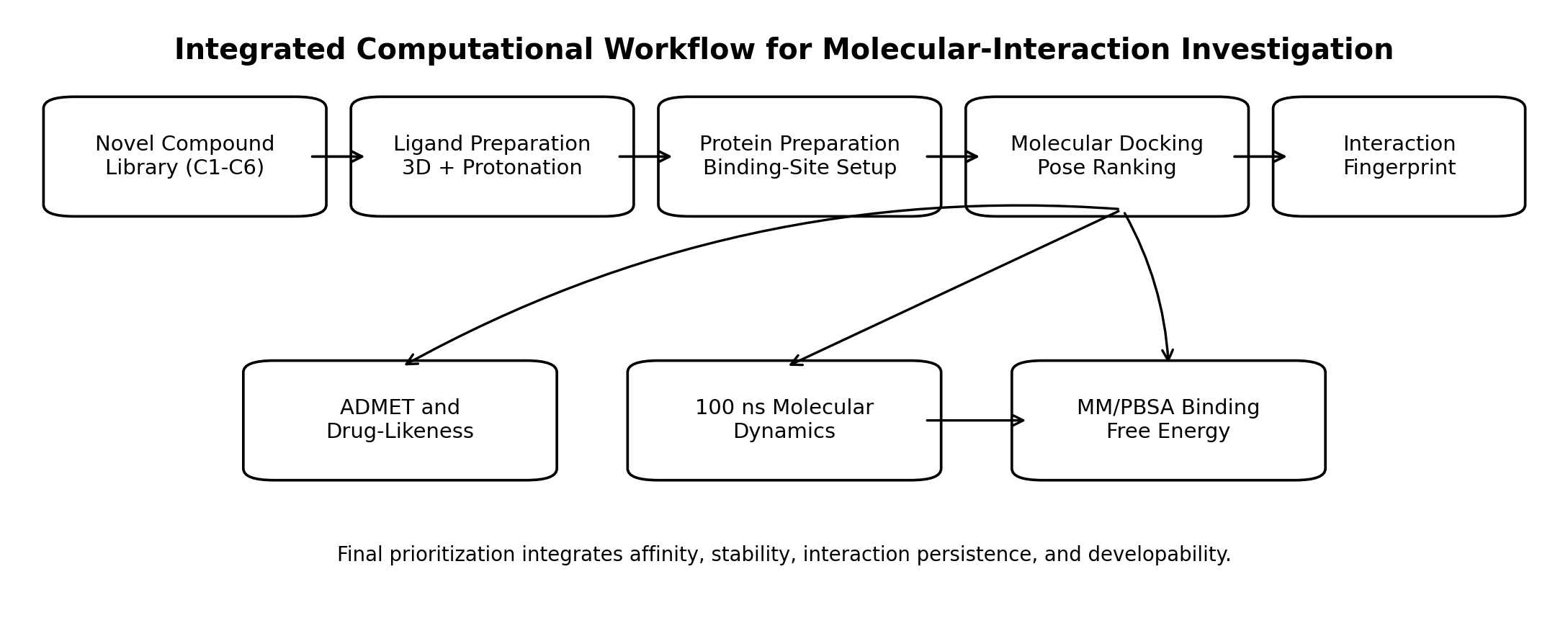
Computational chemistry has become an important component of early-stage pharmaceutical research because it can evaluate molecular recognition, conformational stability, and developability before extensive synthesis and biological testing. This methodology paper presents an integrated in silico framework for investigating the molecular interactions of novel small-molecule pharmaceutical compounds with a selected therapeutic protein target. A six-compound virtual series (C1-C6) is used to demonstrate the workflow. The procedure combines ligand and receptor preparation, molecular docking, protein-ligand interaction mapping, drug-likeness and ADMET prediction, 100 ns molecular-dynamics simulation, and MM/PBSA binding-free-energy estimation. Docking is used for initial pose generation and ranking, while molecular dynamics evaluates whether the predicted complexes remain stable in explicit solvent. Root-mean-square deviation, root-mean-square fluctuation, radius of gyration, hydrogen-bond persistence, and contact occupancy are used as dynamic descriptors. The final prioritization integrates docking score, interaction persistence, MM/PBSA energy, and predicted pharmacokinetic liabilities rather than relying on a single score. Illustrative computational results show how two candidates can be advanced when they combine favorable binding energies with stable trajectories and acceptable drug-like profiles. The methodology is designed to be reproducible, transparent, and suitable for later experimental validation.